
ACORD Form Data Extraction for Insurance: How AI Turns Submissions Into Decision-Ready Data
See how AI-powered ACORD form data extraction captures, validates, and structures submission data automatically, reducing manual work and accelerating underwriting decisions.
Underwriters rarely lose a risk because they misjudged it. They lose it because the data showed up late, or showed up wrong.
ACORD form data extraction is where that problem starts. Before anyone can price a risk, someone has to pull the applicant details, class codes, locations, and loss history out of a PDF and into a system. Most teams still do that by hand, or with template OCR that falls over the first time a broker sends a newer form edition.
This guide is for operations and underwriting leaders who are already comparing options. It covers how AI extraction works, how to test it on your own submissions, what to ask vendors, and where it goes wrong.
TL;DR
- Test on your worst 50 submissions, not the vendor’s demo set. Clean PDFs hide the failures that cost you time.
- Ask for field-level accuracy per form edition. One blended number tells you very little.
- Put the attachments in scope. Loss runs, statements of values, and driver schedules decide whether a file is really quote-ready.
- Extraction without validation just moves errors around faster. Insist on checks against code lists and across documents.
- Find out what happens to the files the system can’t read. That exception path decides your real savings.
- Track straight-through rate and exception rate next to accuracy. A system can score well and still leave a third of your files in a manual queue.
- Ask for a replayable audit trail on every extracted value, especially in regulated lines.
- Price the delay as well as the labor. How fast a broker hears back often matters more than keying hours.
What Is ACORD Form Data Extraction, and Why Does It Break at Scale?
ACORD form data extraction means reading standardized insurance forms, like the ACORD 125, 126, and 140, and turning their fields into structured data your systems can use. It breaks at scale because the forms are standardized in layout but not in how people fill them out, scan them, or send them.
The form is rarely the whole submission, though. Brokers attach loss runs, vehicle and driver schedules, statements of values, and supplemental questionnaires, and each one has its own layout.
Four things make this harder than it looks:
- Edition drift. Forms get revised, and carriers add their own supplements. A template built for last year’s layout misreads this year’s.
- Scan quality. Fax artifacts, skewed pages, and phone photos all degrade character recognition.
- Handwriting and checkboxes. A tick mark sitting between two boxes is a judgment call, not a character.
- Unstructured attachments. Loss runs have no standard layout at all.
What Documents Are Included in ACORD Form Data Extraction for Insurance?
Not all insurance submission documents are structured the same way. While ACORD forms follow standardized formats, attachments such as loss runs and statements of values vary significantly across carriers and brokers. Understanding what information each document contributes, and where extraction errors typically occur, is critical when evaluating ACORD form data extraction for insurance.
Which tasks should stay with people?
Underwriting judgment, exceptions, ambiguous evidence, appetite interpretation, and final decisions. A human-in-the-loop design keeps these with the underwriter
Document |
What it feeds downstream |
Typical extraction failure |
|---|---|---|
ACORD 125
|
Applicant identity, operations, prior coverage
|
Misread entity names; missed checkbox answers
|
ACORD 126
|
Liability exposure, class codes
|
Class code that contradicts the operations description
|
ACORD 140
|
Property values, construction details
|
Transposed digits in values; unreadable roof and protection fields
|
Loss runs
|
Loss history and frequency
|
Column layouts that differ from carrier to carrier
|
Statement of values
|
Location schedules and insured values
|
Merged cells; tables split across pages mid-row
|
The real cost shows up later. One transposed digit on an application can travel through the quote, the bind, and the billing record before anyone catches it.
What Does Manual ACORD Re-Keying Really Cost?
Manual ACORD re-keying typically costs insurance organizations tens of thousands to hundreds of thousands of dollars annually in labor alone, with the true cost often increasing significantly when slower response times lead to missed quoting opportunities and broker attrition.
Manual ACORD processing costs you the labor to key each submission plus the business you lose while it waits. Most teams only count the first part, which makes the problem look smaller than it is.
Start with the simple version: annual submissions × minutes per submission × loaded hourly rate. Then add the cost of delay. How long does a broker wait for a first response, and how many of them send the risk to a faster market instead?
Here's an illustrative example. The numbers are hypothetical, so swap in your own.
- Volume: 1,200 submissions a month, or 14,400 a year.
- Handling time: 35 minutes of keying and checking per submission, which comes to about 8,400 hours a year.
- Loaded rate: $34 an hour, so roughly $285,600 a year.
- Reduction: if extraction and validation take away 70% of that effort, the labor saving lands around $200,000 a year.
One caution on counting. Freed-up hours only turn into cash if overtime, temp staffing, or headcount actually drops. Otherwise you’ve gained capacity, which is still worth having if the team can absorb more submissions without hiring.
The faster-market effect is harder to model and usually bigger. Pull two numbers from your own data: the median time from submission received to first underwriter touch, and your hit ratio by response-time band. That comparison can make the case on its own.
How Does AI-Based ACORD Form Data Extraction Work?
AI-based extraction reads each page as a document with layout and meaning, not as a grid of characters. The values it pulls are then normalized, checked, and passed to your systems with a confidence score attached.
A production pipeline usually runs in six stages:
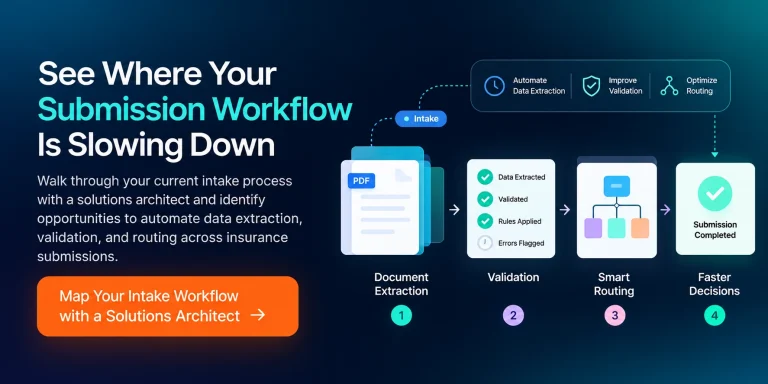
- Ingest and classify. The system picks up files from email, portals, or shared folders and works out what each one is: an ACORD 125, a loss run, an SOV, something else.
- Extract. Layout-aware models and language models read fields, tables, and checkboxes, including ones that move between form editions.
- Normalize. Dates, addresses, entity names, and codes get converted to one format, so “Jan 5, 2026” and “01/05/26” land the same way.
- Validate. Values are checked against code lists and against each other. A class code that contradicts the operations description gets flagged.
- Score and route. Every field carries a confidence score. Low-confidence fields go to a reviewer with the source image attached.
- Deliver. Clean data is pushed to your agency management system, policy admin system, or rater.
Stage five is what separates a usable system from a risky one. Without it, errors go quiet. With it, the system’s uncertainty is visible, and you can measure it.
Xignifi’s Document Intelligence layer follows the same pattern: perception reads the documents, reasoning applies rules and context, and action triggers the next step in the workflow. Whichever platform you evaluate, these are the stages to look for.
How Do OCR Templates, Generic IDP, and Agentic Extraction Compare?
For ACORD-heavy intake, insurance-specific agentic extraction copes with variation best. Template OCR is the cheapest to start and the most brittle at scale, and manual keying is the most flexible and the slowest.
Approach |
Verdict |
Works well when |
Breaks down when |
|---|---|---|---|
Manual keying or BPO
|
Flexible and slow; cost rises in step with volume.
|
Volume is low or submissions are highly irregular
|
Volume spikes, or errors are expensive
|
Template-based OCR
|
Quick to stand up, fragile to change.
|
You see a few fixed forms from known sources
|
Form editions change or brokers send variations
|
Generic IDP or LLM tooling
|
Broad coverage, but you add the insurance logic.
|
Documents vary a lot and you have engineers to build validation
|
You need code-list checks, cross-document consistency, and audit trails out of the box
|
Insurance-specific agentic extraction
|
Best fit for high-volume, mixed-document intake.
|
Submissions mix ACORD forms with messy attachments and you want validated, routed output
|
Volume is too low to justify setup, or data already arrives as structured ACORD XML
|
ACORD has its own tool, Transcriber, which picked up language-model capabilities in 2023, according to ACORD’s announcement. It belongs on any shortlist, since it’s built around the standards themselves.
The practical difference between the last two rows is who owns the insurance logic. With a generic tool, your team builds and maintains the validation rules. With an insurance-specific one, much of that arrives configured and you tune it.
What Should You Evaluate Before Choosing an ACORD Extraction Solution?
Judge a solution on field-level accuracy against your own submissions first, then on what happens when it’s wrong. A demo on clean forms tells you almost nothing about either.
Ten criteria worth scoring:
- Field-level accuracy by form edition. Each form reported separately, including older editions you still receive.
- Scan and handwriting tolerance. Run your worst faxes and phone photos through it.
- Attachment handling. Loss runs, SOVs, and schedules are part of the job, not extras.
- Validation depth. Does it check against code lists and across documents, or only extract?
- Confidence scoring and review queues. Can a reviewer see the source image beside each flagged field?
- Integration. Can it deliver to your AMS, policy admin system, or rater without custom middleware?
- Auditability. Can you replay any run and see the inputs, outputs, and reviewer actions?
- Security posture. Look for independent attestations such as SOC 2 Type II, and confirm how your data is stored and retained.
- Time to deploy. Ask for a timeline based on your forms, not a platform average.
- Pricing model. Per document, per field, or per seat will change your economics as volume grows.
A bake-off you can run yourself:
- Pull 50 recent submissions: 30 typical ones, 10 with poor scans or odd layouts, and 10 with difficult attachments.
- Have two people key the ground truth independently, then reconcile the differences.
- Give every vendor the same files under the same conditions, with no preparation on their side.
- Score field-level accuracy per form, exception rate, and the time it takes to resolve exceptions.
Look hard at the files each vendor fails, not just the average. The pattern of failures shows you what your reviewers would be dealing with on day one.
How Do You Turn Extracted ACORD Data Into Decision-Ready Data?
Extraction gets values out of a PDF, but the data only becomes decision-ready once it’s normalized, checked for completeness, and matched to a next step. A clean field value still doesn’t tell an underwriter whether the file is quotable.
Three steps close that gap:
- Normalize. Reconcile names, addresses, and codes across the application and its attachments, so one insured isn’t recorded three different ways.
- Check completeness. Compare what arrived with what your appetite and guidelines require, such as signatures, effective dates, and prior-loss detail, and request anything missing automatically.
- Route and prepare. Send complete files to the right desk or rater with a summary an underwriter can read in under a minute.
This is where operations teams see the biggest gain. Files stop piling up in manual queues because the system asks for missing information early, not because the keying got quicker.
On the Xignifi side, each of these stages has its own agent: Document Extraction reads the forms, Data Normalization standardizes the output, and Completeness Validation checks the package before it reaches underwriting. For capturing files from email and portals in the first place, there’s Submission Intake. Once the data is clean, Submissions Triage handles prioritizing and routing, and Quote Intelligence picks up from there. You can see how these fit into insurance operations more broadly.
What Metrics Prove ACORD Data Extraction Is Working?
Six numbers will tell you: field-level accuracy, straight-through rate, exception rate, time to first quote, touches per submission, and rework rate. Set each baseline before go-live, because you can’t show an improvement you never measured.
Metric |
Baseline source |
Why leadership cares |
|---|---|---|
Field-level accuracy
|
Audit sample against ground truth
|
Shows data quality at the source
|
Straight-through rate
|
Share of files needing no human touch
|
Converts directly into capacity
|
Exception rate
|
Files that fall out of the automated path
|
Reveals the real manual workload
|
Time to first quote
|
Submission received to quote issued
|
Ties to broker response and hit ratio
|
Touches per submission
|
Workflow timestamps and user actions
|
Shows handoff friction
|
Rework rate
|
Corrections after intake
|
Measures the cost of upstream errors
|
Accuracy alone can mislead. A system can read 95% of fields correctly and still send plenty of files to manual review, because one uncertain field can hold up the whole submission. Straight-through and exception rates show you what your team actually lives with.
Set targets from your own baseline and agree on a review date. Ninety days after go-live is a common first checkpoint, and it’s long enough to include a few messy weeks of real volume. If you’d like to see how other teams have handled the rollout, Xignifi’s case studies are a reasonable place to start.
What Are the Risks and Limitations of ACORD Form Data Extraction?
AI extraction fails most often on unusual layouts, poor scans, and fields where a value has to be inferred instead of read. The risks are manageable if you plan for them, and expensive if you don’t.
- Form-edition drift. New editions and carrier-specific supplements will keep appearing. Ask how the system adapts, how quickly, and who pays for it.
- Poor scans and handwriting. Accuracy drops on low-quality input. The answer is a confidence threshold and a reviewer queue, not a promise of perfection.
- Inferred or invented values. Language models can produce plausible text where a field is blank. Require that every extracted value link back to a spot on the source page.
- Silent errors. The most dangerous failure is a confident wrong answer. Audit a random sample of “approved” files every month, not only the flagged ones.
- Privacy and data handling. Submissions contain personal and financial information. Review state privacy laws and Gramm-Leach-Bliley obligations with counsel, and confirm where data is processed and how long it’s kept.
- Brittle integrations. The best extraction in the world fails if the handoff to your AMS or rater breaks. Test the whole path, not just the reading.
And automation isn’t always the answer. If you get a few dozen submissions a month, the setup effort may never pay back. If your trading partners already send structured ACORD XML, you may need better validation rather than extraction.
Where Should You Start With ACORD Form Data Extraction?
Start small and start with your own files. Pick the one or two forms that dominate your intake, usually the 125 and 126 plus their common attachments, and measure what happens to them today: how long they take, how often they get corrected, and how long brokers wait.
That baseline is worth having whether or not you buy anything. It shows you where the time goes, and it turns every vendor conversation from a feature comparison into a comparison of results. Most teams find the biggest losses sit in a handful of messy submission types, not spread evenly across everything.
From there, run the 50-submission test, review the failures with your own reviewers, and decide whether the exception path is one your team can live with. If it is, expand to the next form. If it isn’t, you’ve learned that cheaply.
Frequently Asked Questions About ACORD form
It's the process of reading ACORD forms and converting their fields into structured data your systems can use. Modern approaches combine layout-aware models with validation rules, so the output gets checked and not just transcribed. The aim is data an underwriter or rater can use without re-keying it.
It depends on the form edition, the scan quality, and the field type, so no single number fits everyone. Typed fields on clean forms are easiest, while handwriting and complex tables are hardest. Test on your own submissions and measure field-level accuracy for each form.
Yes, though accuracy is lower than on clean digital files. Good systems attach a confidence score to each field and send uncertain ones to a reviewer with the source image alongside. Plan for that review step instead of expecting zero exceptions.
Start with the highest-volume forms in your intake, which in commercial lines are usually the 125 and 126 and their common attachments. High volume and a measurable baseline give you the quickest, most defensible payback. Add lower-volume forms once the pipeline is proven.
It depends on how many forms and integrations are in scope. A focused first release covering one or two forms and one downstream system is usually measured in weeks, not quarters. Ask any vendor for a timeline based on your actual documents and systems.
Through an integration layer that maps normalized fields to your system's data model, using an API, a file exchange, or an existing connector. Confirm which method your system supports and who maintains the mapping. Test the delivery step as part of any evaluation.
When volume is very low, or when your partners already send structured ACORD XML. In those cases, validation and workflow improvements often pay off more than extraction. A quick check of your volume and baseline will tell you.
Start with recoverable hours: monthly submissions × minutes per submission ÷ 60 × share automated, minus exception review time. Treat the result as capacity, not automatic headcount savings. It may appear as faster quote turnaround or more submissions handled. Use your own volumes, not a vendor’s averages.
Test Your Own Submissions Before You Commit to Any Platform
The next shift in submission intake probably isn’t better OCR. It’s treating intake accuracy as a service level that operations owns and reports on, the way claims teams report cycle time.
Once field-level accuracy, exception rate, and time to first quote are visible, buying gets simpler. You stop comparing feature lists and start comparing results on your own files. The vendors who welcome that test are usually the ones worth shortlisting.
It also changes what leadership asks for. Instead of “can AI read our forms,” the question becomes how many submissions reach an underwriter quote-ready, and how fast. You can answer that with a sample of 50 files and a few weeks of measurement.
Xignifi’s agents handle extraction, normalization, and completeness validation as one connected workflow, with every value traceable to its source page and every decision logged. But the more useful step right now is a plain one: run your own test, whoever’s platform you try.
Bring One Difficult Submission
Bring one real submission workflow to Xignifi. We’ll map the intake, exceptions, approvals, and downstream actions, so you can see what should be automated before you commit to a platform.
Talk to Xignifi
Stop Losing Time to Manual ACORD Processing
See how much time, effort, and revenue your team could recover with intelligent document extraction and automated submission intake.
Send us a sample of your real submissions. In a working session, we’ll show you:
- Field-level accuracy by form, measured against your own ground truth
- An exception-rate estimate and where those files fall out
- A map of how extracted data would reach your AMS, policy system, or rater
You’ll leave with numbers you can compare against any other option on your list.