
Fine art. Yachts. Luxury real estate. Specialty collectibles. Every one of these submissions comes with its own pile of appraisals, inspection reports, broker emails, and photographs, and every one of them lands on an operations team’s desk in a different format, from a different source, at a different time.
Priya Mehta
Head of Insurance Solutions, Xignifi
Ask most insurers where their hard-to-value asset submissions actually slow down, and the honest answer usually isn’t “underwriting.” It’s everything that has to happen before an underwriter can even start, chasing down a missing appraisal, reconciling two inspection reports that don’t quite agree, confirming a broker actually sent the financial statement they said they did. That’s not risk evaluation. That’s document triage, and it’s eating the hours that should be going to expertise.
Why a Growing Hard-to-Value Asset Book Multiplies Coordination, Not Just Volume
A standard policy scales in a fairly linear way, more submissions, more of the same predictable steps. Hard-to-value assets don’t scale that way. Every additional submission brings its own valuation methodology, its own set of stakeholders, its own combination of documents that may or may not arrive complete. Double the volume of a specialty book and the coordination burden doesn’t just double, it compounds, because each file still needs to be manually assembled and checked before anyone can act on it.
This is the ceiling most insurers eventually hit: not a lack of underwriting talent, but a lack of capacity to keep assembling complete, trustworthy submissions fast enough to keep pace with growth.
Intelligent Document Management Isn't Enough on Its Own
Intelligent Document Management tools have genuinely improved how insurers classify and extract information from unstructured files, a real step up from documents sitting untouched in a shared drive. But classifying a document and understanding whether it belongs to a complete submission are two different problems. A hard-to-value asset file usually needs several records to agree with each other before anyone can act on it, and most intelligent document tools stop at the individual-file level, leaving that cross-checking to a person.
Insurance Document Management Systems Store Files, They Don't Decide Readiness
Most insurers already have an Insurance Document Management system, and it does what it’s supposed to do, records are centralized, retrievable, and compliant. But being able to find a document isn’t the same as knowing whether the submission it belongs to is actually complete. For a hard-to-value asset, a decision rarely rests on one file. It depends on several records agreeing with each other, and confirming that alignment is still, in most operations, a manual job.
That’s why insurers who’ve invested heavily in document storage often find their decision timelines haven’t moved. The documents got easier to find. Nobody automated the part where a person decides the submission is actually ready to be reviewed.
Insurance Workflow Automation Moves Work, Not Judgment
Routing rules, automated notifications, and approval chains have genuinely cut down on administrative drag, a task no longer sits in someone’s queue because nobody remembered to forward it. But Insurance Workflow Automation can move a file from one person to the next without ever answering the question that actually matters: is there enough here to make a decision yet?
That gap, between moving work and evaluating whether the work is ready to be acted on, is exactly where Xignifi is built to sit.
What Xignifi Actually Does With a Hard-to-Value Asset Submission
Xignifi treats a specialty asset submission as a coordination problem first and a decisioning problem second, using a set of purpose-built agents that hand work off to each other the way a well-run operations team would.
Insurance Submission Management, Handled by Agents Instead of People
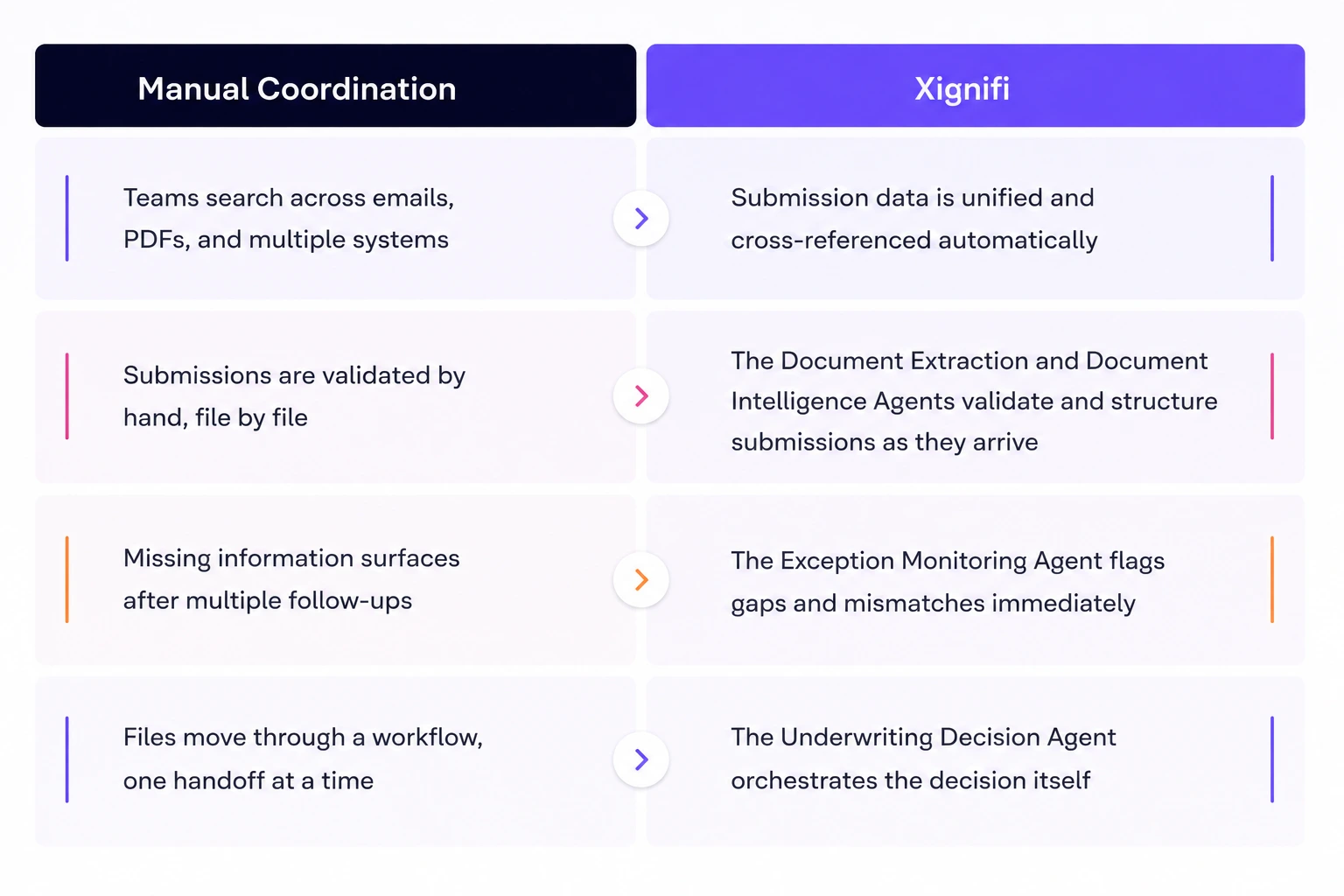
The Submission Intake Agent catches a new hard-to-value submission the instant it arrives and routes it to the right queue based on asset type and complexity, instead of sitting in a shared inbox waiting to be triaged by hand.
From there, the Document Extraction Agent reads whatever’s attached and pulls the specific data points a reviewer will need, regardless of how inconsistently each document happens to be formatted.
The broader Document Intelligence Agent works alongside it, connecting information across the full set of documents tied to a single submission, so a discrepancy between two valuation reports or a missing inspection record gets flagged automatically instead of surfacing three weeks later when someone finally cross-checks everything by hand.
Insurance Decision Automation: Where the Real Time Savings Show Up
Once a submission is structured, the Underwriting Decision Agent evaluates what’s there against the relevant guidelines, moves straightforward, complete files toward a decision, and routes anything incomplete or unusual to a specialist with a clear summary of exactly what’s missing or inconsistent.
Running in parallel, the Exception Monitoring Agent watches for the things that quietly stall specialty submissions and surfaces it before it becomes the reason a file has been sitting untouched for two weeks.
And because specialty and high-value lines tend to draw closer scrutiny, the Compliance Validation Agent and Audit & Reporting Agent work throughout the process rather than at the end of it, checking relevant requirements as the submission moves and logging exactly what data was used and why a decision went the way it did.
Where This Leaves Your Specialty Book
None of this replaces the expertise a hard-to-value asset actually requires, an appraiser’s judgment on a rare piece of art or a marine surveyor’s read on a yacht still needs a person who knows that domain. What changes is how much of a specialist’s week goes to finding, checking, and re-checking information instead of applying that expertise. Xignifi closes the gap between “the submission arrived” and “the submission is ready to be judged”, which, for most specialty operations, is where the real time has always been going.
Frequently Asked Questions
Any asset whose worth can't be determined through standard valuation methods, fine art, collectibles, yachts, luxury vehicles, specialty equipment, and high-value or unique commercial property are common examples.
No. It handles the document coordination and submission-readiness work around a decision, extracting data, flagging gaps, checking compliance, so specialists spend their time on the judgment calls only they can make.
A document management system tells you where a file is. Xignifi's agents tell you whether the submission built from those files is actually complete, consistent, and ready for a decision - and act on that automatically where they can.
Yes, that's the specific job of the Exception Monitoring Agent, which flags gaps, mismatches, and aged documents as they occur rather than waiting for someone to notice during manual review.
No. Xignifi's agents typically sit alongside those systems, structuring and evaluating submission data and handing off a decision, not replacing the systems already in place.
Talk to Xignifi
Talk to our team and see how Xignifi would handle your specialty book.