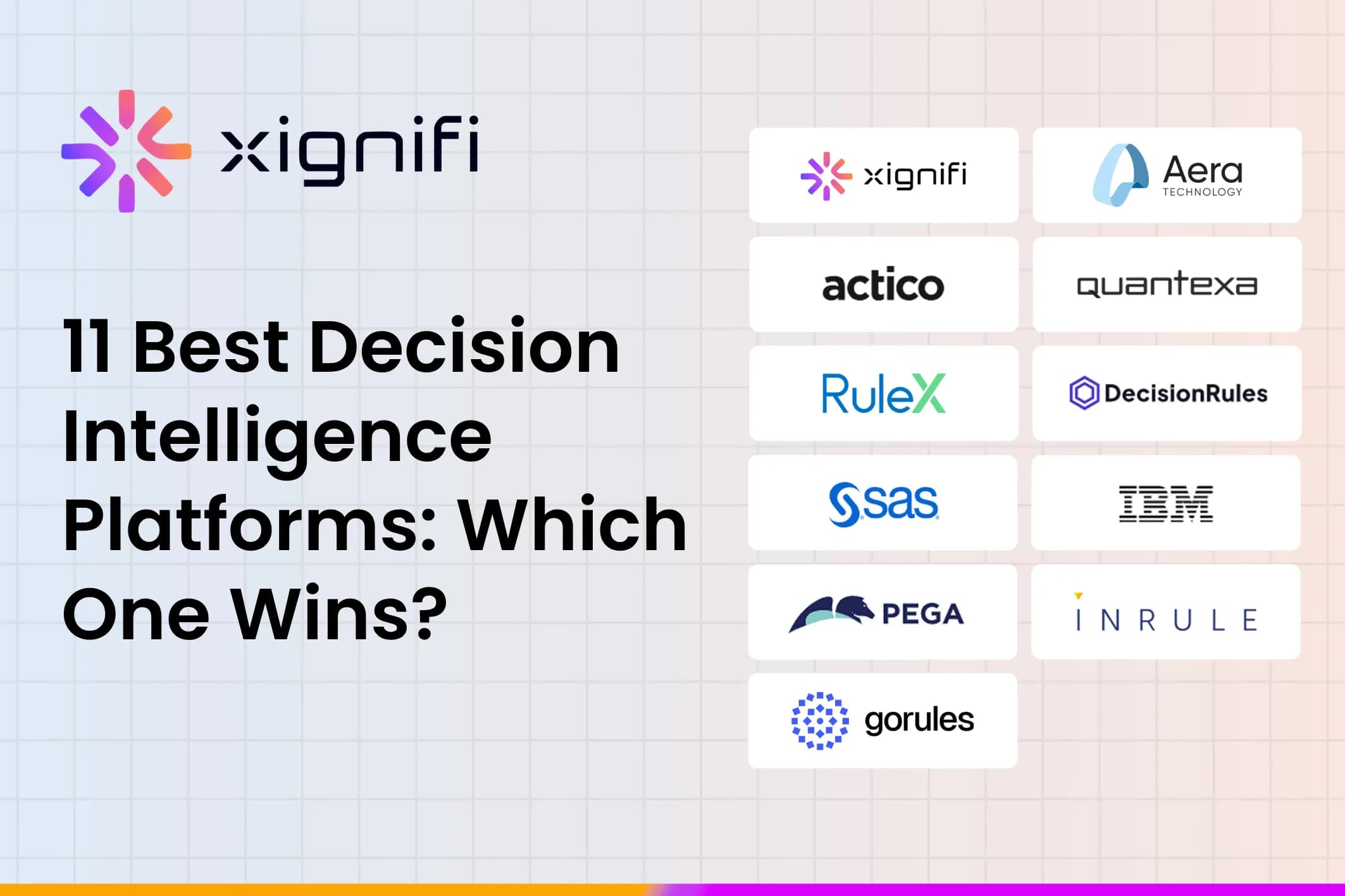
The best decision intelligence platforms in 2026 for banks, insurers, lenders and logistics firms are Xignifi, Aera Decision Cloud, SAS Intelligent Decisioning, IBM Decision Intelligence, ACTICO, Quantexa, Pega Platform, InRule, Rulex, DecisionRules and GoRules. The right choice depends on the decision you make most often and the budget you have.
Decision intelligence is a crowded label.
Rules engines use it. So do planning tools, fraud graphs and agentic platforms. They solve different problems, and a demo rarely shows which kind you are looking at.
That makes shortlisting hard. Pick the wrong kind, and you find out months later, in rework, backlogs, and decisions nobody can explain.
So we narrowed the field. This list covers the 11 decision intelligence platforms most relevant to banks, insurers, premium finance companies, mortgage lenders and logistics firms in 2026.
For each one, you get what it is built for, where it falls short, its analyst standing, and the question to ask before you buy.
Disclosure: Xignifi publishes this guide and is one of the 11 platforms. Every competitor entry follows the same structure, limits included, and draws on vendor documentation, analyst announcements, and public reviews.
TL;DR
- Who this guide is for: operations, technology and risk leaders at banks, insurers, premium finance companies, mortgage lenders and logistics firms.
- What separates a good decision intelligence platform from an expensive one: how it handles messy documents, older core systems, and audit questions on your real cases.
- 11 platforms covered: Xignifi, Aera Decision Cloud, SAS Intelligent Decisioning, IBM Decision Intelligence, ACTICO, Quantexa, Pega Platform, InRule, Rulex, DecisionRules and GoRules.
- Biggest risk most buyers ignore: choosing on demo performance instead of how the platform handles your hardest, messiest cases.
- What to ask every vendor: show the decision log for one real case, with inputs, rule version, model output, human override, and final action.
- What to do after reading this: use the comparison table and decision matrix to shortlist two or three platforms, then pilot them on your hardest cases against your current turnaround, exception rate, and rework.
What does a decision intelligence platform actually do?
A decision intelligence platform turns a business decision into something you can model, run, monitor and change under control. Gartner describes the category as software that supports, augments and automates decisions by people or machines, built from data, analytics, knowledge and AI (Aera Technology).
Business intelligence tells you what happened. A decision intelligence platform decides what to do next for a single case, acts on it in your systems, and keeps a record someone can audit later.
Decision modeling
The decision logic lives outside application code, as rules, decision tables, scorecards or models. Business owners can change a threshold, test it against past cases and release it with a version number.
Data and context
Decisions need clean inputs. Some platforms focus on connectors, others on resolving duplicate records into one customer or counterparty, and others on reading the documents where the inputs arrive.
Prediction, optimization and simulation
Machine learning models score risk or likelihood. Optimization picks the best option under constraints such as budget or capacity, and simulation shows what a rule change would have done to last quarter's cases.
Execution and agents
The platform calls your systems through APIs or workflows, or hands a step to an AI agent. Gartner expects that by 2027, half of business decisions will be augmented or automated by AI agents for decision intelligence (Gartner).
Governance and human review
Every decision should leave a log: inputs, logic version, model output, any human override and the final action. Thresholds decide which cases go to a person before anything happens.
How should you evaluate decision intelligence platforms?
Judge each platform on the decision you will give it first, using your own data. Seven checks separate a platform that runs your operation from one that only demos well.
- 1.Decision fit. The platform should have run your decision type, at your volume, for a firm like yours. Ask: "Show us a live customer making this decision at our volume."
- 2.Data and document intake. Many decisions start in a PDF, an email or a scanned form, not a database row. Ask: "What happens when a required field is missing or two documents disagree?"
- 3.Integration with older systems. Most regulated firms run .NET, Java or mainframe systems alongside cloud tools. Ask: "Which of our systems can you call without custom code, and who maintains each connector?"
- 4.Explainability and audit trail. A regulator, auditor or customer may ask why a decision went one way. Ask: "Show the full log for one decision, including any human override."
- 5.Human oversight. Automation should prepare the case, and people should own the judgment calls. Ask: "Where do we set thresholds that send a case to a person before any action?"
- 6.Change control. Rules change every time a policy, product or regulation changes. Ask: "How does a rule move from draft to production, and who approves it?"
- 7.Time to value. Implementation effort often costs more than the license. Ask: "What did your last three projects of our size take, in months and people?"
How governed are your AI decisions today?
Rate your running system across nine control layers, from identity and oversight to monitoring and compliance, and get a Trust Score out of 45 in about two minutes.
Take the two-minute trust assessmentWhich Decision Intelligence Software Fits Which Kind of Decision?
The 11 platforms are different kinds of tools. The table sorts them by what they are, where they are already in use, how they handle documents, what they cost, and where they stop.
| Platform | Type of tool | Where it is used | Stack and deployment | Document intake | Starting cost | Biggest limit |
|---|---|---|---|---|---|---|
| Xignifi | Document-first AI agents | Policy document processing at a premium finance provider; contract extraction at an insurance distributor | Works alongside existing core systems | Native | About $2,000 to $10,000 per agent a month, plus implementation | Can cost more than a basic rules engine for very small teams |
| Aera Decision Cloud | Agentic supply chain decision layer | Inventory and waste decisions; disruption management at Hershey | Cloud, above existing ERP | Not core | $420,000 per 12-month contract (AWS Marketplace) | Little fit outside supply chain |
| SAS Intelligent Decisioning | Rules plus analytical models | Credit risk, payments fraud and KYC onboarding | Requires SAS Viya | Not core | Hosted Viya 4 Advanced from CAD 408,650 (Canadian price list) | Assumes SAS skills and stack |
| IBM Decision Intelligence | Rules engine and policy-to-rules suite | Vaccination-status decisions for 9M+ citizens, Israeli Ministry of Health | IBM estate assumed; SaaS to z/OS | Via other IBM Cloud Pak products | ODM on Cloud £4,154 per instance a month (partner, UK G-Cloud) | Several products and editions to map |
| ACTICO | Rules engine with packaged banking solutions | Credit decisions at LBBW and SüdLeasing | Cloud; Credit Risk Platform on Salesforce | Not core | From €10,000 one-time, Basic edition (G2) | Packaged for lending and financial crime only |
| Quantexa | Entity resolution and graph analytics | Single client view at Morgan Stanley; fraud, AML and KYC | Needs many source systems mapped | Unstructured data for entity resolution, not document workflows | About £556,000 to £7.74M a year (UK G-Cloud list) | Top-tier license cost and integration effort |
| Pega Platform | Case management with built-in decisioning | Claims routing and next-best action | Requires adopting the Pega platform | Not core | From $35 per user per month, 500-user minimum (TrustRadius) | Rule governance and long rollouts |
| InRule | Business rules engine | Claims adjudication at Fortegra; loan origination rules at Temenos | SaaS, PaaS or on-premises | Not core | $9,500 a month, Commercial SaaS (G2) | Needs a separate tool for document intake |
| Rulex Platform | No-code decision intelligence | Anti-money laundering and fraud detection, including insurance fraud | Business users build in Factory, Studio and Designer | Not core | From €95 per user per month (Capterra) | Horizontal, so less BFSI depth than specialists |
| DecisionRules | Cloud business rules engine | Fraud rule updates at PayJustNow; credit approvals | Public cloud | Not core | Free plan; Lite €3,500 a year | Tight limits below Premium |
| GoRules | Embeddable rules engine | Credit, fraud, KYC and underwriting rules | SDK, microservice or managed cloud | Not core | Free plan; Pro $200, Business $600 a month (G2) | Needs developers; no packaged BFSI content |
Only one platform here handles document intake natively, and prices run from free plans to millions a year. If your decisions start in PDFs, emails and scans, every rules engine on the list needs a separate capture product in front of it, so price that in.
Which Are the Best Decision Intelligence Platforms in 2026?
How we chose these 11: each platform had to run operational decisions such as approvals, routing or rule changes, not only reporting. It had to show at least one public use case in banking, insurance, lending or logistics. And it had to have a cost you can check: a published price, a marketplace listing or a public government price list.
Eight of the 11 are among the 17 vendors in Gartner's 2026 Magic Quadrant. DecisionRules and GoRules are not, and are here as lower-cost rules engines with published plans; Xignifi is not, and is here because we publish this guide. Aera is on the list for logistics and distribution buyers. Xignifi comes first because this is our blog, the others follow their Magic Quadrant position, and the order is not a ranking.
Last reviewed: November 7, 2026.
1. Xignifi: Agentic Decision Intelligence Platform for Insurance Documents
Best for Insurers and Premium Finance Firms Whose Decisions Start in Documents
What it is
A document-first agentic AI platform from Nuvento. Xignifi uses AI agents to read incoming documents, turn them into structured data and pass prepared cases into decision workflows.
How you would use it
Policy documents arrive by several channels in mixed formats. Agents extract and validate the fields and hand the case to quoting, underwriting or financing as structured data, and staff review the exceptions. In insurance intake, the submission triage agent prepares submissions before an underwriter reviews them.
Track record
- Processed 1 million policy documents for a leading premium finance provider, with 90% faster processing, 70% less manual effort and 95% extraction accuracy (case study).
- Automated contract extraction across 18 contract categories for a U.S. insurance distribution platform, with 80% less manual review effort and 95% extraction accuracy (case study).
What you bring
Access to the systems that hold the matching records, a set of real documents for testing, and a person who owns the business rules that cases are routed by.
Who should skip it
Teams whose main decision is supply chain planning, next-best-action marketing or model-heavy credit scoring.
Cost
Agents are subscribed per agent at about $2,000 to $10,000 a month depending on capability, plus a one-time implementation fee of about $15,000 to $75,000 per project.
Limits
Pricing is set for mid-size and large operations. Per-agent subscriptions plus a one-time implementation fee can cost more than a basic rules engine for very small teams or low document volumes, so check the volume at which it pays for itself.
Our take
Built for checks 2 and 3: document intake and working beside the core systems you already run. That is the step most platforms on this list hand to a separate capture product. If your inputs already arrive as clean, structured data, a rules engine further down the list will cost less. Ask: "What would a pilot on our own document types cost, and what would it save at our volume?"
2. Aera Decision Cloud: Decision Intelligence Platform for Supply Chain Decisions
Best for Manufacturers and Distributors Automating Supply Chain Decisions
What it is
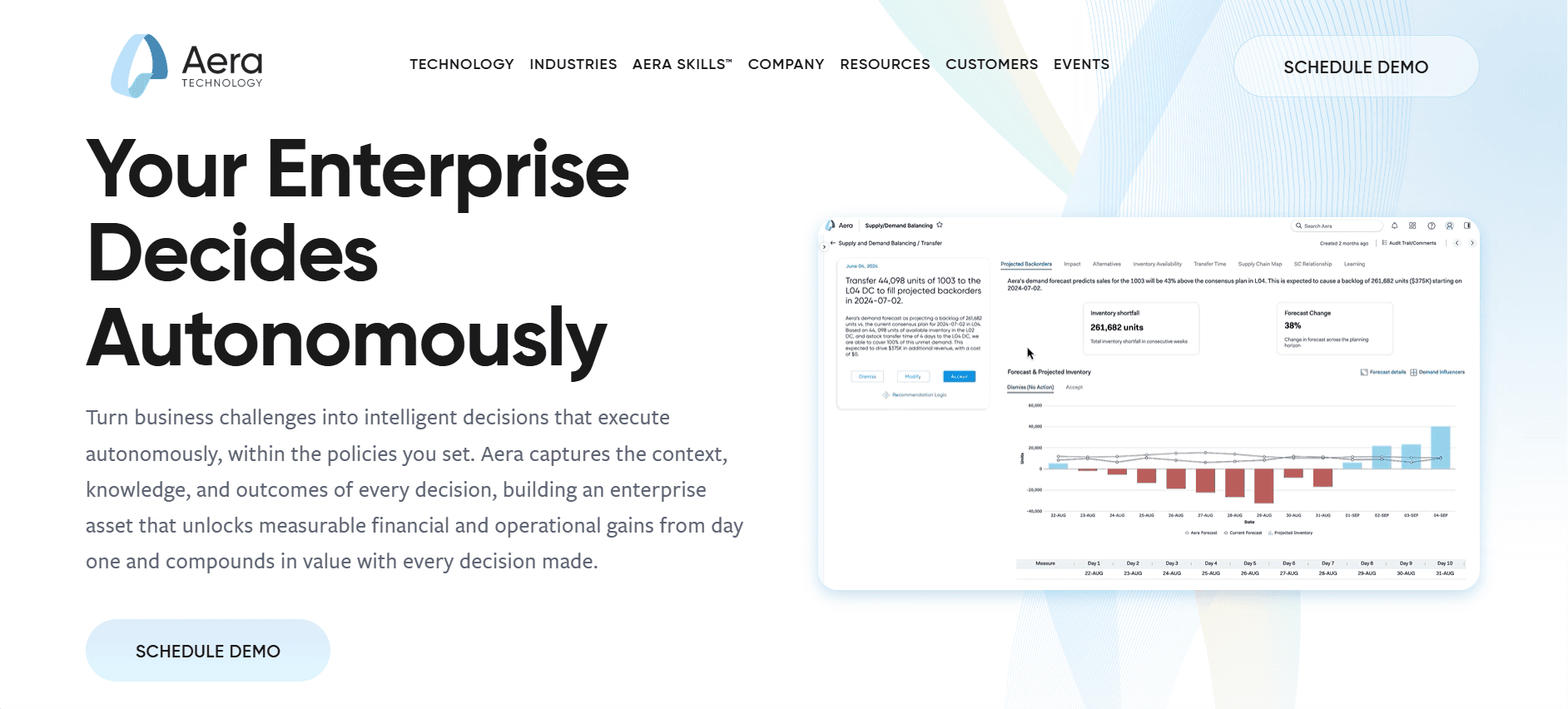
An agentic decision layer for supply chain and procurement. Aera Decision Cloud sits above ERP, source-to-pay and planning systems without replacing them.
How you would use it
A distributor connects Aera to its ERP and supply data. An inventory Skill senses demand and supply changes, recommends a reorder or reallocation, then executes it or sends it to a planner, and learns from the outcome.
Track record
- Supply chain planners cut their workloads by up to 40% (Business Wire, 2025).
- The Hershey Company has discussed using Aera to manage supply chain disruptions (Briefglance, 2026).
What you bring
Clean ERP and supply data, and planners who decide which actions may run without approval.
Who should skip it
Banks and insurers. Its Skills do not cover credit, claims or underwriting.
Cost
Aera Decision Cloud is listed on AWS Marketplace at $420,000 for a 12-month contract, billed in units the listing does not define (AWS Marketplace). Confirm what a unit covers before you compare it with other quotes.
Limits
It is built for supply chain, procurement and revenue management, with little to reuse for credit, claims or underwriting. Its unit-based pricing also makes like-for-like comparison with other quotes hard.
Our take
The most complete agentic option on this list for supply chain decisions, and the wrong tool for anything else. If inventory and procurement calls are your bottleneck, start here. Ask: "Which decisions does the Skill execute alone, and where must a planner approve?"
3. SAS Intelligent Decisioning: Decision Intelligence Tool for Analytics Teams
Best for Banks and Insurers Whose Analytics Teams Already Build Models in SAS
What it is
A decision engine that combines business rules and analytical models on the SAS Viya platform. SAS Intelligent Decisioning runs on public cloud, private cloud or on premises.
How you would use it
A bank's risk team deploys a credit or fraud model built in SAS alongside its policy rules. The loan origination system calls the decision by API in real time, or a batch job scores applications from the database overnight.
Track record
- Applies decision logic in milliseconds for cases such as fraud checks and transaction approvals (SAS).
- Used by financial services teams for credit risk, payments fraud, KYC onboarding and marketing (SAS Communities, 2025).
What you bring
SAS Viya, and analysts who already build models in SAS.
Who should skip it
Teams without SAS skills or data science capacity, and buyers whose bottleneck is document intake.
Cost
SAS does not publish a price for Intelligent Decisioning. The closest public figure is SAS's Canadian government price catalogue, which lists hosted SAS Viya 4 Advanced from CAD 408,650 for up to 10 concurrent users with one production and one non-production environment (SAS price catalogue). Intelligent Decisioning is not priced separately there, so ask what it adds to your configuration.
Limits
The decision layer comes with the wider Viya stack, so price the components and training you would need, not just the decisioning module. Teams new to SAS face a steep learning curve before they can change logic on their own.
Our take
A safe pick when your models already live in SAS, because the decision layer reuses them as they are. Without that investment, you are paying for a platform to get a decision engine. Ask: "Which Viya components does this license require, and what did a customer of our size pay to run them?"
4. IBM Decision Intelligence: Decision Management Suite for Policy-Driven Rules
Best for Large Enterprises That Already Run IBM Automation Software
What it is
A rules and decision management suite. IBM Decision Intelligence handles policy-to-rules authoring, Operational Decision Manager (ODM) runs high-volume rules, and CPLEX handles optimization; the Enterprise Edition bundles all three.
How you would use it
A compliance team writes a policy in plain language, and a watsonx-powered Decision Assistant turns it into traceable rules. The team tests them against defined scenarios and KPIs, then ODM runs them inside approval, claims or onboarding workflows.
Track record
- The Israeli Ministry of Health ran vaccination-status decisions for more than 9 million citizens on ODM (IBM).
- ODM 9.6 shipped in June 2026 and exposes decisions to AI agents through MCP (IBM).
What you bring
Rule authors, and ideally an IBM estate: ODM is pre-integrated with content, capture and process automation in IBM Cloud Pak for Business Automation.
Who should skip it
Smaller teams that want one product rather than a suite, and firms with no IBM software in place.
Cost
IBM sells the client-managed edition as a perpetual license or monthly subscription, charged per pack of 10,000 monthly decision executions plus a site license, or per virtual processor core, without public list prices. For a reference point, partner Responsiv Solutions lists IBM Operational Decision Manager on Cloud at £4,154 per instance per month on the UK G-Cloud marketplace (G-Cloud).
Limits
The stack spans several products, editions and hosting options, so map the exact one you would buy before comparing prices. Document capture comes from other Cloud Pak products, not the decision layer itself.
Our take
Strongest on audit and change control, checks 4 and 6, with the clearest path on this list from written policy to tested rule. The price is complexity: you are buying into a suite, and it fits best where IBM software already runs. Ask: "Show one policy change going from plain text to a tested, approved rule."
5. ACTICO: Credit Decisioning and Compliance Platform for Banks
Best for Banks and Leasing Firms That Need Packaged Credit Decisioning
What it is
A decision management platform with packaged solutions for retail credit decisioning, commercial credit risk and anti-financial crime compliance. ACTICO is based in Germany and was acquired by Keensight Capital in March 2025.
How you would use it
A bank configures its credit policy, rating rules and pricing in ACTICO's graphical modeler and tests the strategy before release. The platform connects to origination, core banking, CRM and credit bureau data, so each application is decided with a documented trail.
Track record
- German bank LBBW runs its own policy and workflow rules on the ACTICO Credit Decision Platform (CaseStudies.com).
- SüdLeasing reached 80% of credit decisions within 48 hours on the Credit Risk Management Platform (CaseStudies.com).
What you bring
Credit policy owners, integration work with your core banking and origination systems, and Salesforce if you use the Credit Risk Platform.
Who should skip it
Insurers and logistics firms without a lending or financial crime use case.
Cost
G2 lists an ACTICO Platform Basic edition starting at €10,000 as a one-time purchase, with larger plans priced on request (G2). The packaged credit and compliance solutions are quoted separately.
Limits
The packaged solutions target lending and financial crime, so anything else is built on the platform layer by you or a partner, and that is where timelines stretch.
Our take
The most lender-specific platform here. Credit teams get packaged logic on day one; everyone else gets a toolkit to build with. Ask: "Which parts of our use case come packaged, and which would we configure from scratch?"
6. Quantexa: Decision Intelligence Platform for Fraud, AML and KYC
Best for Risk Decisions That Depend on Knowing Who Is Connected to Whom
What it is
An entity resolution and graph analytics platform. Quantexa links records from many sources into real-world entities and maps the relationships between customers, counterparties and transactions.
How you would use it
A bank loads customer, transaction and third-party data. Quantexa resolves duplicates into single entities, builds the network around each one and passes the risk signals into AML alerts, fraud checks or KYC reviews.
Track record
- Morgan Stanley gave Quantexa its 2026 Innovation Award for the entity resolution behind a single view of its clients (GlobeNewswire via Generation NT, 2026).
- Ranked 7th in the Chartis Financial Crime and Compliance 50, 2026 (Quantexa, 2026).
What you bring
Access to many source systems and the data engineering capacity to map them.
Who should skip it
Firms whose decisions do not depend on linking records across sources, such as document intake or supply planning.
Cost
Quantexa's UK G-Cloud price list shows annual subscriptions with a multi-year initial term, with platform suite prices from about £556,000 to £7.74 million depending on tier, excluding VAT and third-party data (G-Cloud 15). Its platform suites do not usually cap users, data volumes or transactions.
Limits
Its price list sits at the top of this guide's range, and value depends on mapping many source systems and tuning entity resolution before the first decision runs.
Our take
The specialist when a decision depends on who is connected to whom, and priced like one. For straight-through intake or plain rules work, it is more platform than you need. Ask: "How long did entity resolution take to configure for a customer with our number of source systems?"
7. Pega Platform: Low-Code Decisioning and Case Management Software
Best for Banks and Insurers That Want Decisioning Inside Case Work
What it is
A low-code case management and workflow platform with decisioning built in. Pega adds Customer Decision Hub for next-best action and Credit Risk Decisioning for lending.
How you would use it
An insurer builds a claims case type in Pega. A fraud model scores each incoming claim, Pega Process AI routes suspicious or complex claims to an expert, and routine claims move straight through.
Track record
- Serves 7 of the top 10 insurance companies and 18 of the top 25 global banks (Pega).
What you bring
Pega developers or an implementation partner, and a governance model for rules and versions.
Who should skip it
Teams that want a standalone decision engine without adopting Pega's workflow platform.
Cost
Pega Platform list prices start at $35 per user per month for the Low-code Factory edition and $90 for Standard, with a 500-user minimum on a three-year term, or from $0.45 per case (TrustRadius). At the minimum, the Low-code Factory edition comes to about $210,000 a year. The Enterprise edition is quoted on request, so check whether Customer Decision Hub is included.
Limits
Full Customer Decision Hub deployments can take several months to over a year (FitGap), and rule governance gets heavy as rulesets, versions and environments multiply.
Our take
Worth it if you want decisions and case work in one place and will commit to the platform. If you only need a decision engine, that commitment is hard to justify. Ask: "Who owns rule versions across environments, and how do we audit a decision made six months ago?"
8. InRule: Business Rules and Decision Platform for Insurance and Lending
Best for Insurers and Lenders Running Rules Across Legacy and .NET Systems
What it is
A business rules engine and decision platform that lets business teams author and manage decision logic outside application code. InRule runs as SaaS, PaaS or on premises, which suits firms with older core systems.
How you would use it
An insurer's claims team writes adjudication rules in InRule, the engine runs them inside the claims system, and analysts change rules without a code release. It works with older platforms too: Fortegra Financial runs it across an AS/400 system and newer .NET applications.
Track record
- Fortegra Financial automates thousands of claims a year with InRule (CaseStudies.com).
- Temenos uses InRule in its loan origination platform for data validation and cross-sell rules (CaseStudies.com).
What you bring
Rule authors in the business, and developers to connect the engine to your core systems.
Who should skip it
Teams that need document intake, optimization or supply chain planning in the same product.
Cost
G2 lists a Commercial SaaS edition at $9,500 a month for up to 5,000 transactions a day, billed annually upfront, which comes to $114,000 a year; the Enterprise edition for higher volumes or on-premises use is quoted on request (G2). G2 dates that pricing table to October 2024, so confirm it.
Limits
It is a rules engine, so data preparation and document intake stay in other systems. Plan for a capture tool in front of it if your cases arrive as documents.
Our take
A practical choice for insurers and lenders with mixed legacy and .NET estates who want business users to own the rules. It does one job well, so budget for the tools around it. Ask: "How do business users test a rule change against last month's cases before it goes live?"
9. Rulex Platform: No-Code Decision Intelligence for Fraud, AML and Data Quality
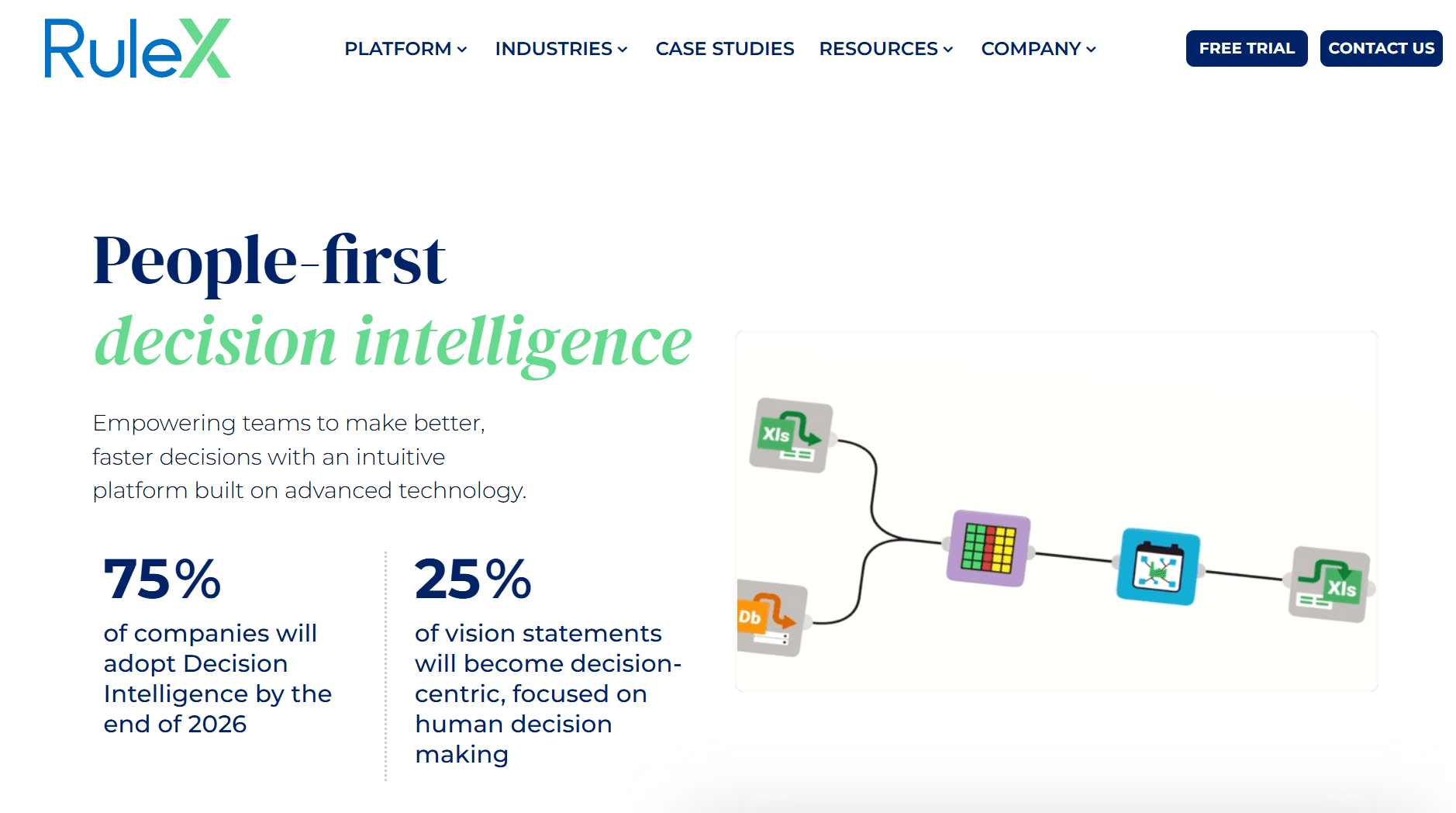
Best for Banks and Insurers That Want Business Users to Build Decision Logic
What it is
A no-code decision intelligence platform that combines data preparation, a rule engine, explainable AI, optimization and scenario simulation. Rulex splits it into Factory, Studio and Designer components.
How you would use it
A bank's compliance team brings transaction data into Rulex, cleans it, builds explainable rules that flag suspicious patterns and runs scenarios before switching them on for anti-money laundering alerts.
Track record
- Case studies cover anti-money laundering, fraud detection and insurance fraud.
- Customers include Banco BPM, Monte dei Paschi di Siena, Banca Ifis and UnipolSai.
What you bring
Business analysts willing to own data preparation and rule building, and access to your source data.
Who should skip it
Firms that want packaged credit or claims solutions, or document intake.
Cost
Capterra lists Rulex Factory Lite at €95 per user per month and Factory Personal at €540 per user per month, with Factory Enterprise quoted per user per year (Capterra).
Limits
It is a horizontal platform serving six industries, so its banking and insurance content is thinner than at specialists such as ACTICO or Quantexa. Enterprise deployments are quoted separately from the per-user plans.
Our take
Good value for analysts who want to build explainable fraud and AML rules themselves. Less so if you want a vendor to hand you a finished credit or claims solution. Ask: "Can you show an anti-money laundering or fraud deployment at a firm our size, and who built the rules?"
10. DecisionRules: Low-Cost Rules Engine for Loan Approval and Risk Scoring
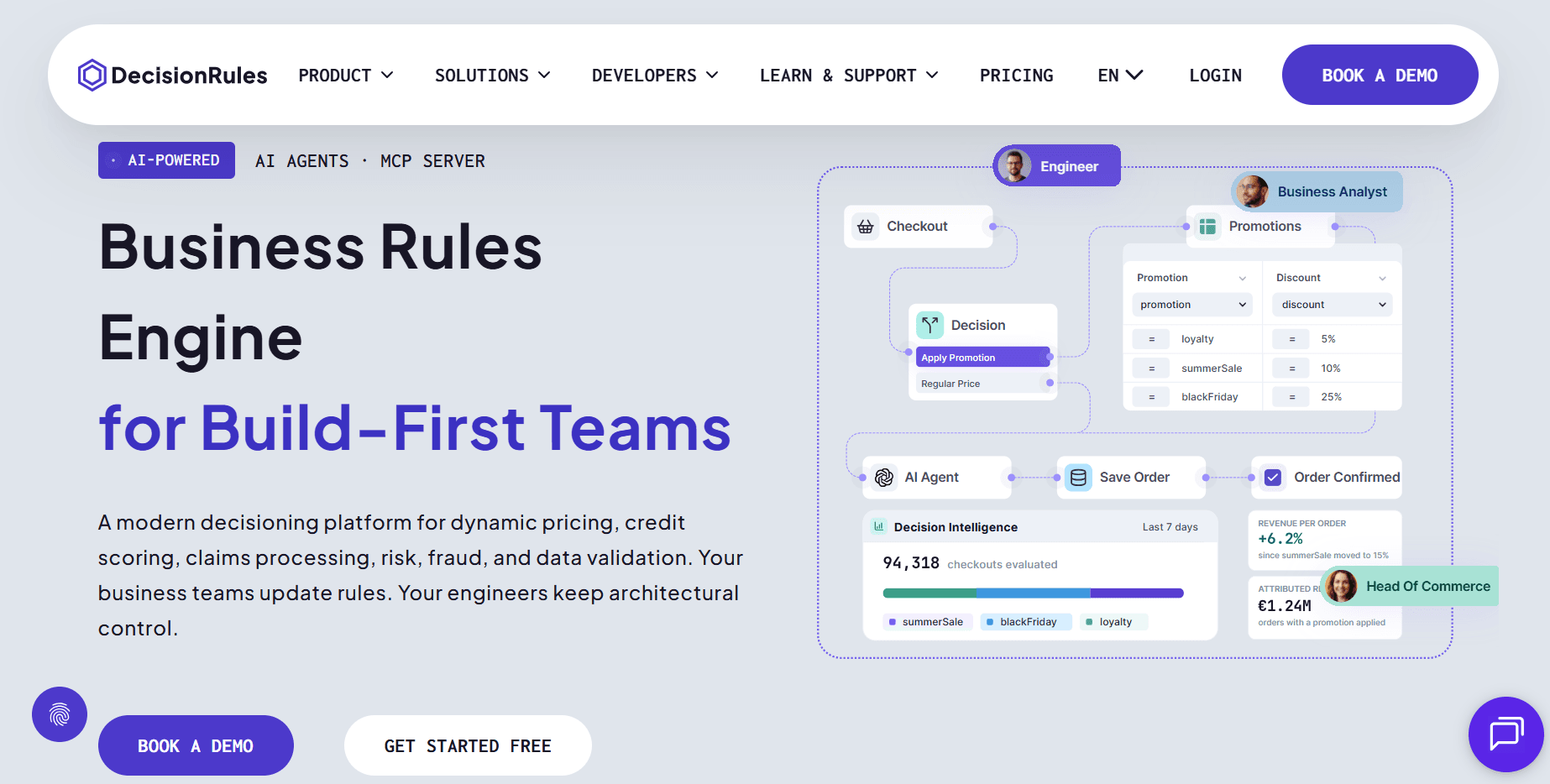
Best for Lenders and Fintechs That Want to Change Credit Rules Without Developers
What it is
A cloud business rules engine with decision tables, rule flows and ready-made templates for credit decisioning. DecisionRules runs as a managed service, so a small risk team can start without setting up infrastructure.
How you would use it
A consumer lender builds approval and risk-based pricing rules from templates, pulls bureau data from Equifax or Experian, and updates rules live without developer input.
Track record
- PayJustNow, a South African buy-now-pay-later provider, says fraud rule updates that once took days now go live in minutes (DecisionRules).
- The company cites 95% faster loan approvals and 4x faster rollout of compliance updates.
- SOC 2 Type II and ISO 27001 certified.
What you bring
Credit or risk analysts who own the rules, and an origination system that calls the rules API.
Who should skip it
Large enterprises that need document processing, case management or optimization in one platform.
Cost
DecisionRules publishes its cloud prices: a Free plan for 10 rules and one user, Lite at €3,500 a year (about €291 a month) for 30 rules and 10,000 API calls, and Premium on quote (DecisionRules). It notes the figures are approximate and set in the order form.
Limits
The Free and Lite plans cap rules, decision table rows and API calls tightly, so most production use will need Premium, which is priced on quote.
Our take
The fastest, cheapest way on this list for a lender or fintech to get credit rules out of application code. Budget for Premium once volume grows. Ask: "What would our expected monthly API call volume cost on Premium?"
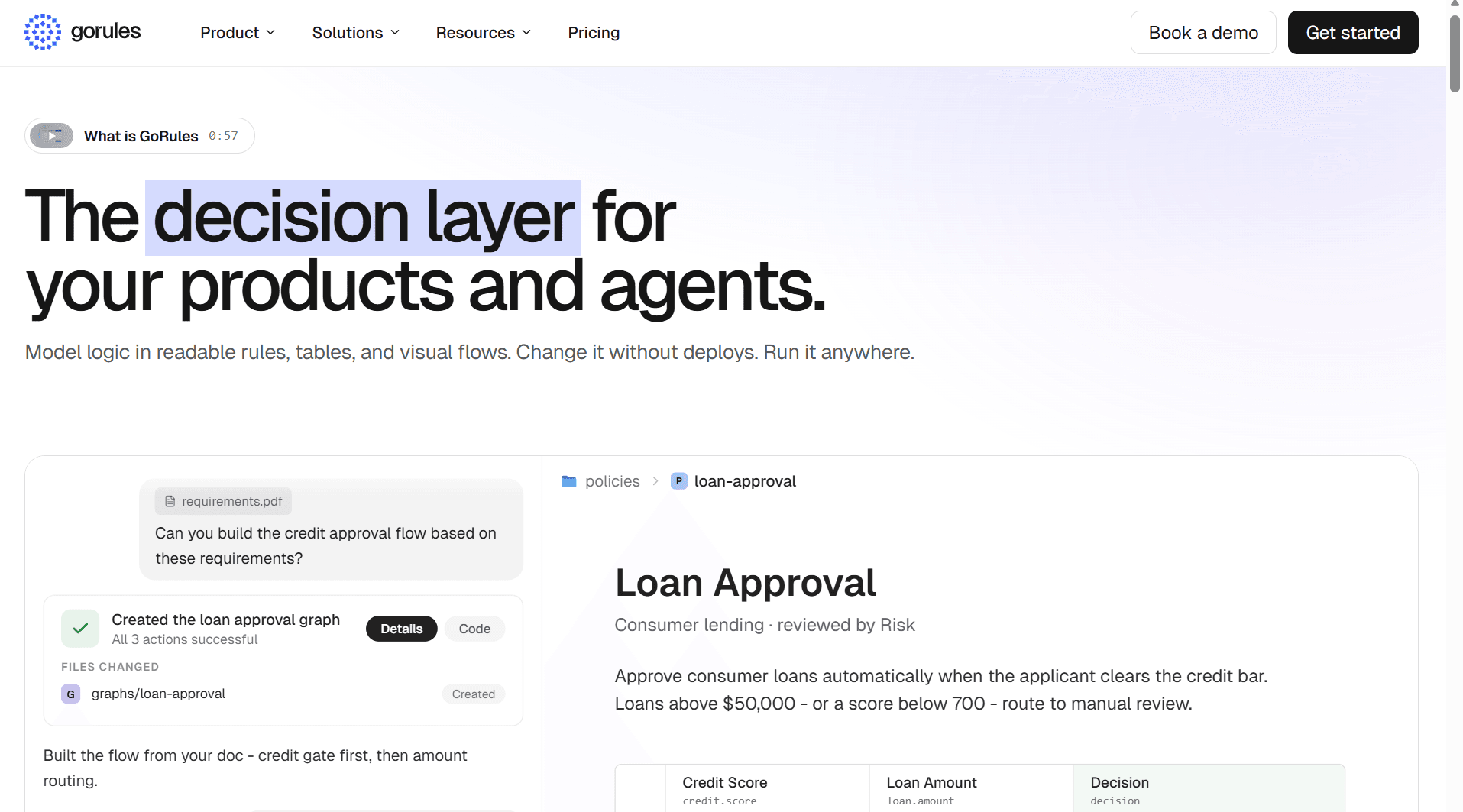
11. GoRules: Embeddable Decision Engine for Credit, Fraud and Underwriting Rules
Best for Engineering Teams That Want to Embed Business Rules in Their Own Apps
What it is
A business rules engine that separates decision logic from application code. With GoRules, teams model rules visually, test them in a simulator and publish updates without redeploying the application.
How you would use it
A fintech's engineers embed the GoRules engine in its loan application through a native SDK. Risk analysts then model credit scoring and KYC rules visually, test them in the simulator and publish changes without a release.
Track record
- Use cases include credit scoring, fraud detection, loan approval, KYC and AML, underwriting, claims processing and premium calculation.
- Runs embedded through SDKs, as a microservice or in the managed cloud.
What you bring
Developers to embed, host and maintain the engine.
Who should skip it
Business teams without engineering support, and firms that need end-to-end workflow or document intake.
Cost
G2 lists GoRules cloud plans at Free, Pro at $200 a month, Business at 600amonth(500 on annual billing) and Enterprise on quote, with a self-hosted edition that has a free tier and paid plans from €50 a month (G2).
Limits
It is built for developers rather than business users working alone, and it ships no packaged credit or claims content, so your team writes every rule.
Our take
A strong engine for engineering-led teams on a small budget, especially if you want rules inside your own product. Not for business teams without developer support. Ask: "Which of our current rules would we migrate first, and who maintains the SDK integration?"
How Do You Choose Between These Decision Intelligence Platforms?
Match the platform to your highest-volume decision first, then test integration and audit. This decision matrix gives a starting shortlist for seven common situations.
| If your main decision is | Shortlist | Because | Watch for |
|---|---|---|---|
| Consumer or commercial credit approvals | ACTICO, DecisionRules, SAS | Credit rules, scoring and audit features built for lenders | Rule changes that still need a developer release |
| Fraud, AML or KYC across many data sources | Quantexa, Rulex | Entity resolution and explainable rules for risk decisions | Long data mapping before the first live decision |
| Insurance underwriting, rating and claims rules | Xignifi, InRule, Pega, IBM | Business-owned rules running inside claims and policy systems | Old rules left running in legacy systems after go-live |
| Document-heavy intake: submissions, policies, contracts and applications | Xignifi | Document processing and agents in one flow | Accuracy shown only on clean demo documents |
| Supply chain, inventory and logistics planning | Aera | Decision models built around demand and supply | Little proof outside supply chain |
| Next-best action across customer channels | Pega, SAS | Real-time decisioning inside each interaction | Thousands of offers and rules with no clear owner |
| Embedded rules for product teams on a small budget | GoRules, DecisionRules | Published plans that start free | Plan limits and the engineering effort to embed |
Get a Shortlist Built Around Your Decisions
Tell us the decision, the systems it touches, and your budget. We will send back two or three platforms, ours included, with the questions to ask each one.
What Does a Decision Intelligence Platform Cost?
Prices in this category vary by more than a thousandfold. DecisionRules and GoRules start with free plans, ACTICO's Basic edition is listed from €10,000 one-time, InRule's Commercial SaaS edition is listed at $9,500 a month, Aera Decision Cloud is listed at $420,000 for a 12-month contract, and Quantexa's UK government price list runs from about £556,000 to £7.74 million a year.
Total cost depends on decision volume, the number of systems to connect, the hosting model, the specialist skills needed to change logic and the implementation services around it. License fees are often the smaller part of year one.
Build a three-year comparison for each finalist: license, implementation, connectors, internal staff time and the cost of each rule change. Ask each vendor for the effort behind its last comparable project, in months and people.
Decision Intelligence Platforms: Frequently Asked Questions
How do we build a business case for a decision intelligence platform?
Start with what the current process costs, not with the vendor's ROI slide: hours of manual review per case, cases per month, rework rate and the delay each backlog day adds. Those numbers set the baseline every vendor must beat. Xignifi's ROI calculator sizes what your current backlog costs, which gives finance a figure to test quotes against.
How quickly can a decision intelligence platform show results?
A scoped pilot on one high-volume decision should show measurable change within weeks, not quarters, if the vendor works on your real files from day one. Measure turnaround, manual effort and accuracy against your baseline. In Xignifi’s insurance distribution case study, a U.S. platform cut manual contract review effort by 80% across 18 contract categories.
What should a decision intelligence proof of concept include?
A useful proof of concept runs on your own data and systems, covers one or two decisions, and is judged on numbers agreed before it starts. Ask for accuracy, processing time, the share of cases that needed a person and compatibility with your core systems. Include your messiest files, and agree in writing what happens if the targets are missed.
How do we check a platform's governance before we sign?
Ask the vendor to show the full record for one real decision, including inputs, rule version, model output, any human override and the final action. Then check who can change a rule, who approves it and how long logs are kept. To see where your own controls stand first, take Xignifi's two-minute trust assessment, which scores nine control layers out of 45.
How is decision intelligence different from business intelligence?
Business intelligence reports what happened, usually through dashboards that a person reads before acting elsewhere. Decision intelligence acts on individual cases: it applies rules and models, triggers the next step in your systems and logs why. Many firms run both, with BI for monitoring and decision intelligence for execution.
Can a decision intelligence platform replace underwriters or credit analysts?
No. A well-run platform takes preparation work off people's desks, such as collecting documents, checking fields and applying clear-cut rules. Underwriters and analysts keep the judgment calls, the exceptions and the cases your thresholds send for review.
Do decision intelligence platforms work with legacy systems?
Most connect through APIs, batch jobs or prebuilt connectors, but depth varies widely by platform. Ask each vendor which of your systems it can call today without custom code, and who maintains those connectors after go-live.
How should we run a decision intelligence pilot?
Pick one high-volume decision with a measured baseline for turnaround, exception rate and rework. Run the pilot on your messiest real cases, keep a person reviewing every output at first, and compare results with the baseline before widening scope.
Editor's note: Fix the Inbox Before You Buy the Rules Engine
When teams compare decision intelligence platforms, they argue about rules engines and models. In our work, the decision logic is rarely where the time goes. At one leading premium finance provider, policy documents arrived through several channels in mixed formats, and staff had to review, extract, validate and transform each one by hand before it could support quoting, underwriting or financing.
Once that preparation was automated, manual processing effort fell by 70% and policy processing ran 90% faster. We saw the same thing with contracts at a U.S. insurance distribution platform. The slow part was finding terms in thousands of SharePoint files, and automating that extraction cut manual review effort by 80%.
The reason is simple. A rule can only be as fast as the inputs that reach it, and in insurance, premium finance and mortgage work, those inputs arrive as emails, PDFs and scans that disagree with each other and with the core system. A platform that assumes clean data moves the backlog from one desk to another.
If I were running your evaluation, I would start where the work enters, not where the rule fires. Take the files your team reworked last month, the incomplete ones and the ones in odd formats, and give the same set to every platform on your shortlist. Whichever one turns that pile into clean, complete cases with the least help from your team is the one that will move your backlog.
Your takeaway for this week: pull ten cases your team reworked last month and write down why each one stalled. If most stalled on a missing, late or conflicting document rather than on the rule itself, put document intake at the top of your vendor scorecard and test it first.
Build Your Shortlist Around Your Hardest Files
Tell us which files your team reworks most. We will show you which platforms on this list can turn them into ready cases, and which cannot.