AI Quote-to-Bind Automation: What Can Be Automated Between Submission and Quote?
A normal working day and the broker sends a submission at 9 a.m. By the time an underwriter actually looks at it, it’s often lunchtime the next day. But what you don’t see is that very little of that gap is underwriting.
It’s opening attachments, re-keying values, checking whether the account is already in the system, hunting for missing loss runs, and waiting for someone to pick it up. Quote-to-bind automation goes after exactly that stretch, and the first half, between submission and quote, is where most of the time hides.
This guide is for Chief Underwriting Officers, MGA COOs, and underwriting transformation leads who are past the “should we?” stage. It walks through which steps AI can take over, which should stay with your underwriters, how to evaluate vendors, and where the risks sit.
TL;DR
- Automate the data and the checks first. Leave authority and risk selection with underwriters until your rules are written down.
- Most of the delay sits before an underwriter touches the file. Measure submission-to-first-touch time before you measure anything else.
- Intake, clearance, and completeness checks are the safest first moves. They’re rule-heavy, high-volume, and easy to audit.
- Rating is not an all-or-nothing step. Let AI handle standard risks inside your authority limits and route deviations as referrals.
- Write your authority matrix before you configure anything. If you can’t say who may approve what, no tool will say it for you.
- Pilot one line of business and one broker segment. A narrow test shows you the exception path, and the exception path decides your savings.
- Track straight-through quote rate and referral rate next to cycle time. Fast quotes that need rework aren’t fast.
- Budget for filing and compliance review. A quote that doesn’t match your filed rates and forms is a liability, not a time saving.
What Is Quote-to-Bind Automation, and Where Does Submission-to-Quote Fit?
Quote-to-bind automation means using software, increasingly AI agents, to move a risk from submission through quote and into a bound policy with as little manual handling as that risk allows. The slowest stretch is usually the first half, between submission and quote, so that’s where most of the opportunity sits.
A typical commercial submission passes through roughly ten steps before it's bound:
- Receive the submission and classify what’s in it
- Extract and normalize the data
- Clear it against existing accounts
- Screen it against appetite and eligibility
- Enrich it with third-party data
- Check for gaps and chase the broker
- Triage, prioritize, and assign
- Rate and price
- Assemble and check the quote
- Deliver the quote, then handle the bind order
Steps one through nine are the “submission to quote” span. Step ten is where quote turns into bound business. Each step has a different automation profile, which is why “automate underwriting” is too blunt to be useful as a goal.
Where Does the Time Actually Go Between Submission and Quote?
Most of it goes to administrative work around the risk, not to the risk decision itself. The best-known measure comes from the long-running underwriter survey Accenture runs with The Institutes. Accenture’s write-up of the findings reports that the average underwriter spends about 40% of their time on administrative tasks, 30% on negotiation and sales support, and only 30% on underwriting.
Here's an illustrative example of what that looks like in dollars. These figures are hypothetical, so replace them with your own.
- Volume: 600 commercial submissions a month, or 7,200 a year.
- Handling time: about 150 minutes of combined effort per submission across intake, data entry, clearance, enrichment, rating, and quote assembly, which is 18,000 hours a year.
- Reduction: if automation removes 40% of that effort, you free about 7,200 hours.
- Loaded rate: at a blended $55 an hour, that’s roughly $396,000 a year.
Don’t book all of that as savings. Freed hours become cash only if overtime, temps, or hiring actually drop. If the team absorbs more submissions with the same people, that’s capacity, and it’s still worth having.
The bigger prize is usually speed. Pull your own numbers on median time from submission received to first underwriter touch, and compare your hit ratio by response-time band. Brokers send risks where the answer comes first.
What Can Be Automated Between Submission and Quote?
Most of the pre-quote work can be automated or heavily assisted. What should stay with a person is the judgment on unusual risks, anything outside your authority limits, and the final call on exceptions. Here’s how each step breaks down.
Submission-to-Quote Automation Map: What AI Can Handle at Each Step
Step |
What AI can handle |
What stays with a person |
Control to keep |
|---|---|---|---|
Intake and classification
|
Pick up email and portal submissions, identify each document, split packets
|
Unrecognized or corrupted files
|
Source log for every file
|
Extraction and normalization
|
Read ACORD forms, loss runs, SOVs; standardize names, dates, and codes
|
Fields below the confidence threshold
|
Source-page link for each value
|
Clearance
|
Match against existing accounts, flag duplicates and conflicts
|
Ambiguous matches
|
Match reasons recorded
|
Appetite and eligibility
|
Screen against written rules and guidelines
|
Borderline or declined accounts a broker is pushing back on
|
Rule version and reason code
|
Enrichment
|
Pull third-party data, geocode locations, add exposure details
|
Anomalies and conflicting sources
|
Data source and timestamp
|
Completeness and follow-up
|
Compare against requirements, draft and send requests for missing items
|
Sensitive or high-value brokers
|
Message templates approved by underwriting
|
Triage and routing
|
Score, prioritize, and assign to the right desk
|
Overrides and reassignments
|
Override reasons logged
|
Rating and pricing
|
Call the rater and price standard risks within authority
|
Deviations, referrals, and anything unusual
|
Authority matrix and referral rules
|
Quote assembly and checks
|
Draft the quote, attach forms, check terms against filings
|
Review above set premium or non-standard terms
|
Compliance checks and sign-off record
|
Steps one, three, and ten (quote delivery and follow-up) are the easiest to hand over almost completely. Steps two, four, five, six, seven, and nine work well with automation plus review. Step eight is where most teams should go slowly: automate the standard case, and make everything else a referral.
If you’re picking a first project, look at steps two through four. They’re high-volume, rule-heavy, and easy to measure. Xignifi covers these with separate agents: Submission Intake for step one, Document Extraction and Data Normalization for step two, and Completeness Validation for step six. Submissions Triage handles routing, and the Quoting Agent generates compliant quotes from submission data.
Where Should Underwriters Stay in the Loop?
Keep underwriters in charge of authority, exceptions, and novel risk. Automate the data gathering and the rule checks around those decisions, and give underwriters better information to make them with.
A few principles hold up across lines of business:
- Write down the authority matrix first. Who can approve what premium, for which class, under which conditions? If it lives in people’s heads, automation will either stall or guess.
- Automate inside the lines, refer outside them. A risk that fits cleanly within appetite, pricing rules, and authority can flow through. Anything else becomes a referral with the reasons attached.
- Make overrides cheap. Underwriters should be able to correct the system in a click and have that correction recorded. If overriding is painful, they’ll stop trusting the tool.
- Show the reasoning. A routing score or appetite decision with no explanation gets ignored. One with the three factors that drove it gets used.
- Sample the approvals. Review a random slice of auto-approved files every month, not just the flagged ones.
The point isn’t to reduce underwriter judgment. It’s to stop spending that judgment on retyping.
How Does Automation Carry Through From Quote to Bind?
It carries through by treating the bind as the last checkpoint of the same workflow, not a separate project. Once a broker accepts a quote, the same data, documents, and rules should drive the bind order checks, subjectivity tracking, and policy issuance without re-entry.
In practice that means:
- Bind order validation: confirm the order matches the quote terms, effective date, and any subjectivities before it goes further.
- Subjectivity tracking: keep a live list of outstanding conditions and chase the missing ones automatically.
- Policy verification: cross-check the issued policy against the quote and endorsements, which is the job of Xignifi’s Policy Verification agent.
- Downstream handoff: pass clean data to billing, premium finance, and the policy admin system.
Teams that automate only the front half often find the bind stage becomes the new bottleneck. It’s worth designing the full path even if you phase the rollout.
How Do You Evaluate Quote-to-Bind Automation Options?
Evaluate on how a solution handles your own submissions and your own authority rules, then on what it does when it’s unsure. A polished demo on a clean, simple risk shows you very little.
There are four broad approaches on the market. If extraction is your starting point, ACORD’s own Transcriber tool, which added language-model features in 2023, is worth a look alongside the platforms below.
Quote-to-Bind Automation Approaches Compared: Where Each Works and Where It Breaks
Approach |
Verdict |
Works well when |
Breaks down when |
|---|---|---|---|
Rules engines and RPA scripts
|
Reliable for fixed steps, brittle at the edges.
|
Inputs are consistent and stable
|
Documents vary or rules change often
|
Automation inside your rater or policy system
|
Strong on rating, thin upstream.
|
Your core system already covers most of the flow
|
Data arrives unstructured from email and PDFs
|
Generic document AI plus a workflow tool
|
Flexible, but you build the insurance logic.
|
You have engineering capacity and a clear spec
|
You need appetite rules, referrals, and audit trails built in
|
Agentic orchestration with insurance-specific agents
|
Best fit for mixed-document, multi-step intake.
|
Submissions are messy and you want steps coordinated end to end
|
Volume is low, or your process is still undefined
|
Nine questions to put to any vendor:
- Which steps between submission and quote does it cover, and which does it leave to you?
- How are authority limits and referral rules configured, and who can change them?
- What happens to a file the system can’t handle? Show the exception path.
- Can every decision be traced to its inputs, the rule version, and the person who approved it?
- How does it connect to your rater, policy admin system, and agency management system?
- How does it handle filed rates, forms, and state-specific requirements?
- What are the security attestations, and where is data processed and retained?
- How long to a first live line of business, based on your documents?
- How is it priced as volume grows?
A pilot you can run yourself:
- Choose one line of business and one broker segment with enough volume to measure.
- Record your baseline first: time to first touch, time to quote, touches per submission, and referral rate.
- Run the automated path alongside the manual one for a few weeks, with underwriters reviewing outputs.
- Compare results, then study the exceptions closely. They show you what day one in production looks like.
Which Metrics Prove Quote-to-Bind Automation Is Working?
Use seven numbers: submission-to-first-touch time, submission-to-quote time, touches per submission, straight-through quote rate, referral rate, quote correction rate, and hit ratio. Capture each baseline before go-live, because improvements you can’t compare against won’t convince anyone.
Seven Metrics to Baseline Before Go-Live
Metric |
Baseline source |
Why leadership cares |
|---|---|---|
Submission-to-first-touch time
|
Workflow timestamps
|
Shows how long brokers wait before anyone looks
|
Submission-to-quote time
|
Received to quote issued
|
The headline speed measure
|
Touches per submission
|
User actions per file
|
Reveals handoff friction and rework
|
Straight-through quote rate
|
Quotes issued with no manual handling
|
Converts directly into capacity
|
Referral rate
|
Share routed to senior review
|
Shows whether authority rules fit reality
|
Quote correction rate
|
Quotes revised after issue
|
Catches speed that costs accuracy
|
Hit ratio
|
Bound quotes ÷ quotes issued, by response-time band
|
Connects speed to revenue
|
Two of these deserve a warning. Straight-through rate can be gamed by loosening your referral rules, so always read it next to correction rate. And hit ratio moves for many reasons beyond speed, so look at it by response-time band instead of expecting one clean line.
Agree a review date up front. Ninety days after go-live is a sensible first checkpoint. If you’d like to see how other teams have rolled this out, Xignifi’s case studies are a good starting point.
What Are the Risks and Limitations of Quote-to-Bind Automation?
The main risks are quotes that don’t match your filings, authority that drifts without anyone noticing, and poor input data that automation then amplifies. All of them are manageable with the right controls, and all of them hurt if you skip those controls.
- Filing and compliance gaps. A quote has to match your filed rates, forms, and state requirements. Build compliance checks into the quote step, not after it.
- Regulatory expectations for AI. The NAIC’s Model Bulletin on the use of AI systems by insurers sets out what regulators expect: a written AI program, plus due diligence on AI systems and data you source from third parties. Adoption is state by state. A law-firm tracker from Quarles counted 24 states as of March 2025, so check where you write business today.
- Data security obligations. The NAIC Insurance Data Security Model Law has been adopted in many states, and it requires licensed entities to maintain an information security program and to oversee their third-party service providers. Any automation vendor handling submissions falls under that oversight.
- Authority creep. Rules loosen over time because it’s convenient. Version your authority matrix, review it on a schedule, and log every change.
- Bad inputs, faster. The survey above found inconsistent submission data was the top drag for underwriters. Automation won’t fix a broker who sends incomplete packets, so build the follow-up into the workflow.
- Rubber-stamping. Reviewers who see 99 correct outputs start approving the hundredth without looking. Sampling and random audits keep reviews honest.
- Broker experience. Automated chase emails can sound cold or repetitive. Have underwriting approve the templates, and let relationship accounts bypass them.
- Brittle integrations. The best logic fails if the handoff to your rater or policy system breaks. Test the full path.
- Auditability. Regulators and reinsurers will ask how a quote was produced. Audit trails and replayable runs are a requirement here, not a nice-to-have.
Automation also isn’t always the answer. If you handle low volumes of highly bespoke specialty risks, the setup effort may never pay back. If your guidelines change every few weeks, fix that first or automation will keep chasing a moving target.
Where Should You Start With Quote-to-Bind Automation?
Start with the unglamorous steps. Intake, extraction, clearance, and completeness checks are where the minutes pile up, where the rules are clearest, and where a mistake is cheapest to catch. Get those running on one line of business and you’ll learn more in a few weeks than any vendor demo can tell you.
Then decide, step by step, how far automation should reach. Some teams stop at assisted underwriting for years and are happy with it. Others push standard risks straight through to a quote inside defined limits. Either is a legitimate choice, as long as the authority rules behind it are written down and someone owns them.
What you shouldn’t do is wait for a perfect, end-to-end design before moving. A narrow pilot with honest measurement beats a long roadmap every time.
See a compliant quote built from a real submission
Watch how Xignifi’s Quoting Agent turns submission data into a quote that follows your rules and filings.
Frequently Asked Questions
It's the use of software and AI agents to move a risk from submission to quote to bound policy with less manual handling. It covers steps like intake, data extraction, clearance, appetite checks, rating, quote assembly, and bind processing. The aim is to cut cycle time and admin work while keeping underwriting control.
Intake, document reading, data normalization, clearance, appetite screening, enrichment, completeness checks, and routing are the strongest candidates. Rating and quote assembly can be automated for standard risks within your authority limits. Risk selection on unusual accounts should stay with an underwriter.
For standard, clearly in-appetite risks within defined authority, yes, some carriers and MGAs do. Anything outside those limits should become a referral, with the reasons attached for the underwriter. How far you go is a business and regulatory decision, not a technical one.
A focused first release covering a single line of business and a handful of steps is usually measured in weeks, not quarters. Timelines grow with the number of forms, integrations, and approval rules involved. Ask any vendor for an estimate based on your own documents and systems.
Usually, through APIs, file exchange, or existing connectors, but this varies a lot by system and version. Confirm the method, who maintains the mappings, and how errors are handled. Test the full round trip as part of any evaluation.
Build compliance checks into the quote step itself, validating terms and forms against your filings before anything goes out. Version your rules, log every decision, and sample approvals regularly. Have compliance review the configuration before go-live and at each material change, and check it against any state AI guidance that applies to you.
Automating intake, extraction, clearance, and completeness checks for one line of business. These steps are high-volume and rule-heavy, and they make the rest of the workflow cleaner. They also give you a baseline and an exception pattern to learn from.
Editor’s Note: Pick One Line of Business and Prove It in Weeks
The constraint in most underwriting operations isn’t technology. It’s decision rights. Teams that automate well have usually done the hard, unglamorous work of writing down who can approve what, and under which conditions.
Once that’s on paper, the technology question gets easier. You can see which steps are safe to automate, which need review, and which should stay with your underwriters. You can also hold any vendor to a clear standard, because you know what “good” looks like on your own files.
The next few years will probably reward the teams that treat speed to quote as an operating metric they own and report, not a side effect of buying a tool. That starts with measuring one line of business honestly.
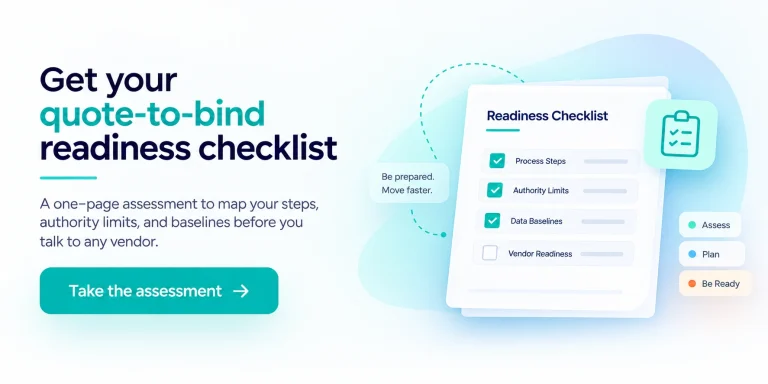
Xignifi’s agents cover the path from submission intake to quote and bind as one connected workflow, with every decision logged and every approval gated. In the assessment below, we’ll map your steps to an automate, assist, or keep-human split, show where time goes today based on your own baseline, draft an authority and referral matrix for the automated path, and estimate the time you’d recover.
Talk to Xignifi
Find out what you can automate before you buy anything
Bring one line of business and a sample of recent submissions. We’ll map your submission-to-quote steps and give you a pilot plan you can take to your leadership team.