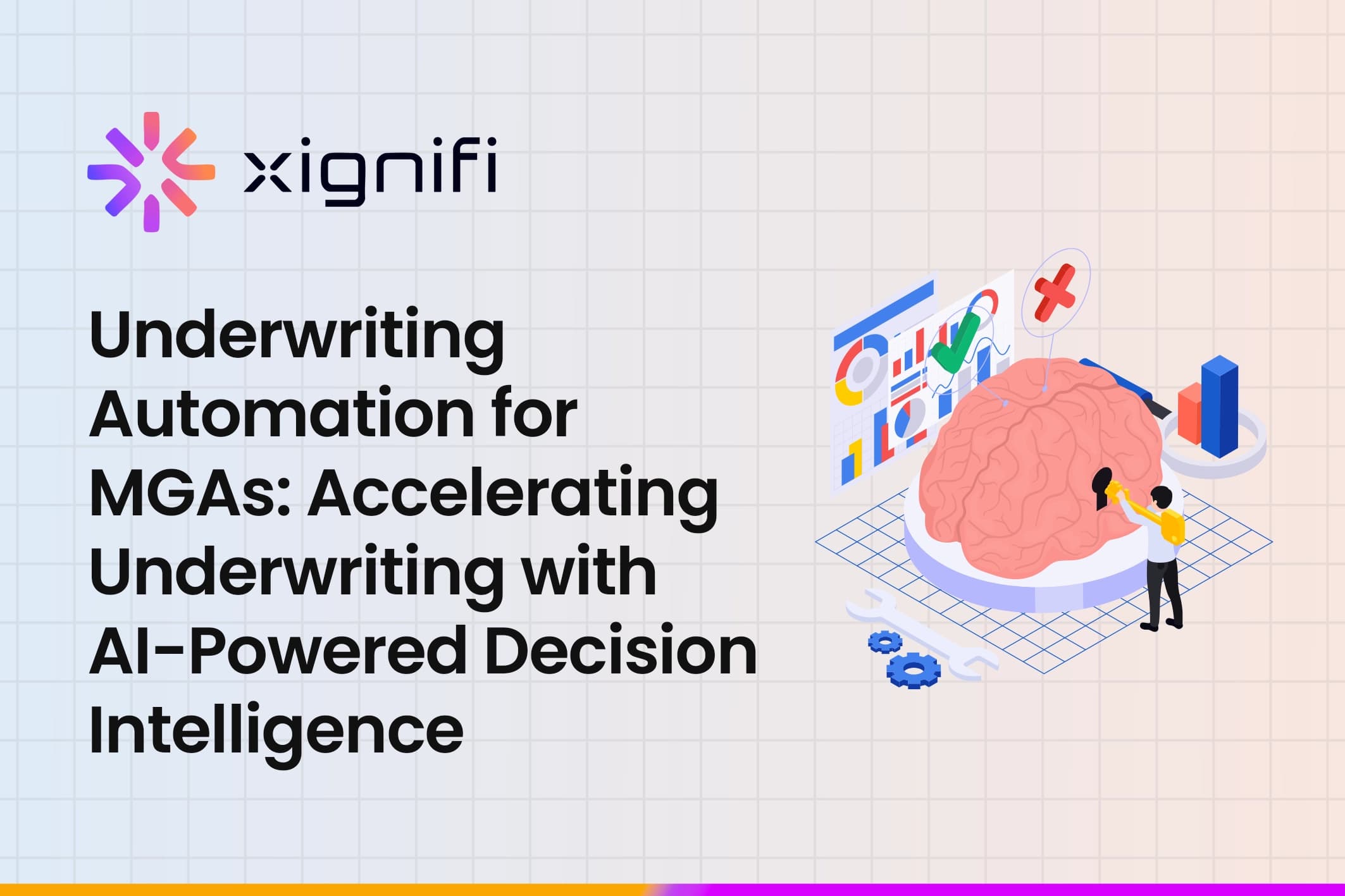
This isn't a generic case for “adding AI” to your underwriting desk. It's a look at the specific problems MGAs run into because of how delegated authority works, and how Xignifi's agents address each one directly.
Why MGAs Need Insurance Underwriting Software Built for Delegated Authority
A carrier's underwriting team usually has scale on its side, dedicated ops staff, in-house compliance, and systems built and maintained specifically for their book of business. An MGA doesn't always have that luxury. You're underwriting on someone else's paper, which means every submission carries two obligations at once: get the risk right, and prove to the carrier that you got it right.
That second obligation is where generic tools start to fall short. Insurance underwriting software built for carriers often assumes a single set of guidelines and a single audit relationship. An MGA usually manages several, different binding authority terms, different reporting requirements, sometimes different appetite across multiple carrier partners on the same book. Xignifi was built with that reality in mind, rather than assuming a single carrier's rulebook is the only one that matters.
The Real Cost of Underwriting Without Insurance Workflow Automation
A typical MGA underwriting desk without workflow automation runs a version of this process: a broker submission arrives as a PDF or scanned packet, someone manually keys the applicant, property, or risk details into an underwriting system, a separate person cross-checks it against the carrier's binding authority guidelines, and a third step routes anything unusual to a senior underwriter for sign-off. Each handoff adds delay. Each manual entry adds a chance for error. And at renewal or audit time, reconstructing why a decision was made becomes its own project, because the reasoning lived in someone's head or an email thread, not in a system of record.
Three consequences show up consistently in MGA operations running this way. Submission-to-bind cycles stretch out, because low-risk applications wait in the same queue as complex ones, and brokers notice, sending repeat volume wherever the response is fastest. Underwriting criteria drift, because without a system enforcing consistency, different underwriters, or the same underwriter on different days, can apply carrier guidelines slightly differently, which is exactly what carrier audits are designed to catch. And underwriting capacity gets absorbed by low-value work, with underwriters spending a large share of their week on data entry and document review instead of the judgment calls that actually require their expertise.
What Automated Underwriting Actually Changes for MGA Teams
Automated underwriting doesn't mean removing underwriters from the process. It means removing the parts of the process that never needed a person in the first place, so the people you do have are spending their time on risk, not re-keying. Inside Xignifi, that runs through a set of purpose-built agents working together.
Insurance Document Automation Solves the Intake Problem First
Broker submissions, policy declarations, and supporting documents arrive in mixed formats, PDFs, scanned images, sometimes structured data feeds. Xignifi's Document Intelligence Agent extracts that information automatically into a consistent, structured record, named insured, policy terms, payment schedule, credit references, instead of a person retyping it field by field into an underwriting system.
Document Classification Agent Sorts Submissions Before an Underwriter Ever Sees Them
Before extraction can happen accurately, the system needs to know what it's looking at. As part of that same intake step, Xignifi recognizes whether an incoming file is an application, a loss run, an inspection report, or a financial statement, and routes the right data fields from each into the underwriting record automatically, without a person doing that sorting by hand.
Automated Underwriting Turns Structured Data Into a Risk Decision
Once the data is structured, Xignifi's Credit & Risk Scoring Agent evaluates it against defined risk criteria and, where relevant, external data sources, credit information, loss history, property or exposure data, returning a risk score and the reasoning behind it. The Underwriting Decision Agent then orchestrates the outcome: straightforward, low-risk submissions that clear defined thresholds move straight toward approval, while anything borderline or high-risk routes to a human underwriter with a pre-built case summary instead of a raw document to dig through. Running alongside this, the Compliance Validation Agent checks carrier binding authority guidelines and any relevant state-specific requirements before an application can move to bind, while the Audit & Reporting Agent logs every step of the decision automatically, often the single most valuable output for an MGA's relationship with its carriers.
Where Insurance Workflow Automation Pays Off for MGAs
MGAs that move from manual processes to Xignifi's connected underwriting workflow typically see change in a small number of specific places: submission-to-bind time drops because low-risk applications no longer wait behind complex ones in the same queue; straight-through processing rates rise as a defined share of submissions clear automatically without losing underwriter oversight on the cases that need it; and audit readiness improves because the decision trail is captured automatically instead of reconstructed after the fact. None of this requires replacing the underwriting team or the carrier relationship it sits inside, it changes what the team spends its time on.
Frequently Asked Questions
No. AI handles document extraction, data structuring, and initial risk scoring for straightforward cases, while routing complex submissions to a human underwriter with the risk factors already summarized. The judgment call stays with the underwriter.
Insurance underwriting, loan underwriting, securities underwriting, and forensic underwriting. MGAs operate within insurance underwriting, typically under a carrier's delegated binding authority.
Software that evaluates applications against defined risk criteria and data sources to approve, decline, or refer a case for manual review, with minimal manual work on straightforward submissions.
By checking carrier binding authority and regulatory requirements automatically before bind, and logging the reasoning behind every decision, so an audit relies on a system record instead of someone's memory of why a case was approved.
No. It typically sits alongside a policy administration system, extracting and structuring data, running risk and compliance checks, and handing off a decision, not replacing the systems already in place.
It varies by book of business, but the time saved usually comes from removing manual document review and re-keying on the share of submissions that are genuinely low-risk, freeing underwriters to spend more of their week on cases that need real judgment.
No. Smaller MGAs often feel manual bottlenecks more acutely, since there's less staff capacity to absorb them, automation tends to have an outsized impact on submission speed and audit readiness at exactly that scale.
Talk to Xignifi