
On a recent mid-market property submission, the loss run listed a policy effective date eleven days off from the ACORD form. The completeness check caught it before the file reached the underwriter – not as an error message, but as a flagged discrepancy with both source values shown side by side.
None of it is hard for an experienced underwriter to understand. The problem is that someone has to turn it into something assessable before underwriting can even start. And that someone is usually the underwriter.
That preparation work is what insurance submission automation targets. Not the underwriting decision itself, but the administrative layer that sits in front of it: receiving, classifying, extracting, validating, and routing submission data so the underwriter’s first real task is assessing risk, not assembling a file.
Xignifi is a Decision Intelligence platform for regulated industries – insurance, banking, financial services, supply chain, and legal. It is built to turn unstructured, document-heavy workflows like submission intake into audit-ready, decision-ready records without displacing the people who make the final call.
Ready to identify the highest-impact AI opportunities in your insurance operation?
TL;DR
- Insurance submission automation should remove administrative work, not underwriting judgment. The two are frequently conflated, and that conflation is what makes buyers nervous.
- The highest-value starting points are intake, extraction, completeness checks, and routing – not pricing, rating, or bind decisions.
- Accenture’s 2024 underwriting survey still finds underwriters spending more than a third of their time on non-core work, largely unchanged from 2021 despite years of automation investment. This means most “automation” so far hasn’t touched the real bottleneck.
- 98% field-extraction accuracy sounds safe. It isn’t, if the 2% includes a material coverage detail – confidence scoring and exception routing matter more than raw accuracy.
- The practical rollout pattern is one line of business first, benchmarked against current cycle time, before expanding, not an enterprise-wide rollout on day one.
- Submission automation and underwriting automation are related but distinct: one prepares the file, the other extends into decision support.
What Is Insurance Submission Automation Actually Automating?
Insurance submission automation automates the operational work of turning an incoming broker submission into a structured, validated, and routed underwriting record. That typically means document classification, data extraction, completeness checks, and workflow routing, while material underwriting judgment stays with a licensed underwriter.
What happens between a broker email and an underwriter's desk?
In most commercial lines shops, a submission goes through several handoffs before anyone assesses risk: receipt, document classification, data extraction, completeness and duplicate checks, validation against appetite, triage, and routing to the right underwriter or team. Each handoff is currently manual in a lot of organizations, and each one is a place where a submission can sit for hours before anyone even opens it.
Why is submission intake different from underwriting automation?
Submission intake is preparation. Underwriting automation is decision support or decisioning itself – risk scoring, pricing guidance, or automated referral logic. They get talked about interchangeably, but conflating them is exactly what makes underwriting leaders skeptical of “automation” as a category.
How Can Insurance Submission Automation Work Without Replacing Underwriters?
It works by drawing a hard line between what gets automated, what gets AI-assisted, and what stays a human decision. Holding that line consistently rather than letting automation creep upward into judgment calls is how the system “proves itself.”
We at Xignifi call this the Automate / Assist / Human Decision model.
A 3-Zone Model for Safer AI

This shows where automation earns trust fastest (Automate), where it needs a human checkpoint before acting (Assist), and where it shouldn’t act at all (Human decision). The failure mode most vendors sell around is quietly letting Assist-tier output get treated as a decision.
How Does an Automated Insurance Submission Intake Workflow Work?
1. Capture
submissions arrive by email, portal, upload, or API and get logged automatically, regardless of format.
2. Extraction
ACORD forms, loss runs, schedules of values, and supplemental documents get parsed into structured fields, including scanned and inconsistently formatted attachments.
This is the same extraction layer that’s processed over 1M policy documents for a premium finance provider. It was the volume that exposed whether an extraction engine actually holds up on messy, inconsistent broker paperwork, or just performs well on clean demo data. You can read the full case study here.
3. Completeness and validation
the system checks for missing fields, missing documents, and conflicting values (a policy effective date that doesn't match the loss run, for example) before the file ever reaches an underwriter.
4. Triage and routing
submissions get scored against appetite, line of business, and urgency, then routed to the right team.
5. Underwriter review
the underwriter opens a structured file with source evidence attached and exceptions already flagged, rather than a stack of unopened attachments.
Step 5 is where most vendors undersell the value. The goal isn’t a faster inbox, it’s a submission the underwriter can actually start evaluating the moment they open it.
What Are the Biggest Risks of Insurance Submission Automation?
Treat these as the questions a good RFP should force a vendor to answer, not as reasons to avoid automation:
Extraction errors.
No extraction engine is 100% accurate on messy, inconsistent broker documents. The question isn't whether errors happen - it's whether they're caught before they reach a decision.
False confidence.
A system that returns a value with no confidence score, and no way to flag it as uncertain, is more dangerous than one that occasionally says "I'm not sure."
Poor exception handling.
Automation that silently drops unusual submissions into a generic queue defeats the purpose - exceptions need to route to a human fast, not get buried.
Integration gaps.
Submission automation that doesn't talk cleanly to the underwriting workbench or policy admin system creates a second system of record instead of removing one.
Governance and audit trail.
In a regulated line, every automated decision – even a routing decision – needs to be explainable after the fact. In a regulated line, every automated decision – even a routing decision – needs to be explainable after the fact, an expectation that’s now explicit in the NAIC’s Model Bulletin on AI use by insurers.
That’s what Xignifi’s document intelligence layer is built to preserve.
How Do You Know Which Parts of Submission Intake Should Be Automated?
Run each task through five questions before automating it: Is it repetitive? Is the input observable and consistent enough to extract reliably? Can the output be validated? What happens if the system gets it wrong? And does it require material underwriting judgment?
Tasks that fail the last question – anything touching coverage interpretation or acceptance – stay human regardless of how well they score on the first four. That’s the boundary from the table above, applied as a repeatable test rather than a one-time decision.
How Should an MGA Introduce Insurance Submission Automation Without Disrupting Underwriting?
Start with one submission type rather than the full book. A single line of business gives you a controlled test without disrupting the whole intake pipeline. Before switching anything on, benchmark current intake: processing time, re-keying rate, incomplete-submission rate, and time-to-underwriter.
Set explicit human-review rules – confidence thresholds, exception triggers, escalation paths – before go-live, not after the first mistake. Only expand to additional lines once the first one is proven against your own baseline, not a vendor’s case study.
Is Insurance Submission Automation the Same as Underwriting Automation?
No. Submission automation prepares and organizes information before underwriting begins. Underwriting automation extends further into risk scoring, pricing guidance, and in some implementations, automated decisioning.
Submission intake is the layer that makes underwriting automation trustworthy in the first place: it’s hard to automate a decision responsibly on top of data nobody validated. If you’re further along and evaluating decision-layer automation directly, that’s the underwriting automation conversation, not this one.
What Questions Do Insurance Leaders Ask About Submission Automation?
No. A properly scoped system automates preparation and administrative processing while underwriters retain control over material risk judgment and final acceptance decisions.
Yes, provided the system can classify varying document types and attachment formats and flag low-confidence extractions for review rather than accepting them silently.
Values the system isn't confident about should route to a human reviewer rather than get passed through as if verified. That's the difference between assistive automation and a black box.
It depends more on submission complexity and integration requirements than on the vendor. A single line of business with clean data integrates faster than a multi-LOB rollout against legacy systems.
Triage - scoring and routing submissions by priority - is one component of the broader workflow.
Submission automation spans intake, extraction, validation, triage, and routing together.
Talk to Xignifi
Curious where your own intake process is actually losing time?
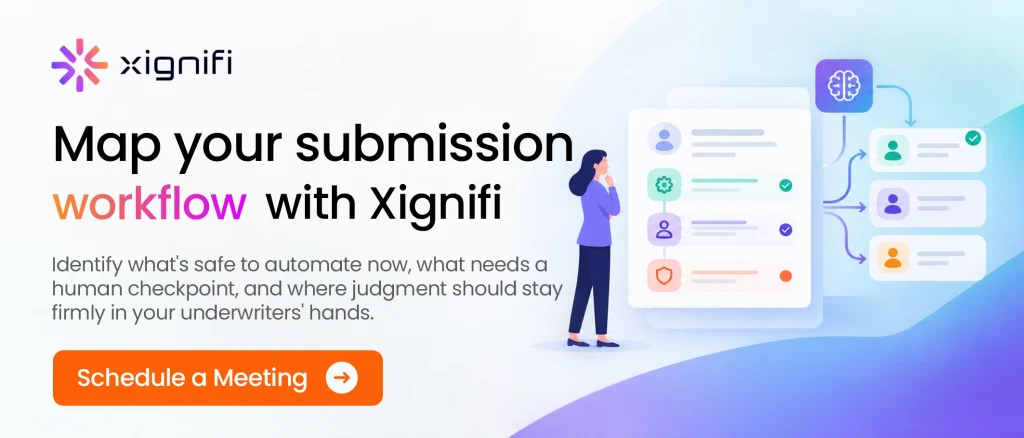
Xignifi can map the submission journey from broker intake to underwriter review and flag where automation would help and where it shouldn’t.
Editor's Note: Where Insurance Submission Automation Earns Its Keep
The insurance industry loves to promise transformation. Most of what gets sold as “automation” today is just a faster inbox and nothing more. The real shift is quieter, and harder to put on a slide. It’s the slow disappearance of the paperwork standing between a broker’s email and an underwriter’s judgment.
That’s the part worth watching. Not because AI is getting smarter at underwriting – it isn’t, not in any way a good underwriter should worry about. But because the operational layer around underwriting is finally doing its actual job: turning a messy submission into decision-ready evidence fast enough that speed stops being traded against accuracy.
Give it a few years and “submission automation” stops being a pilot line item and starts being table stakes, the way OCR did a decade ago. The MGAs and carriers that treat it as infrastructure now will be the ones setting broker response-time expectations instead of chasing someone else’s.
That’s the boundary Xignifi’s decision intelligence platform is built around: automate the preparation aggressively, keep the judgment human, and make every step in between auditable. Not because it’s the cautious answer, but because it’s the only one that actually scales.