Underwriting Automation for MGAs: Accelerating Underwriting with AI-Powered Decision Intelligence
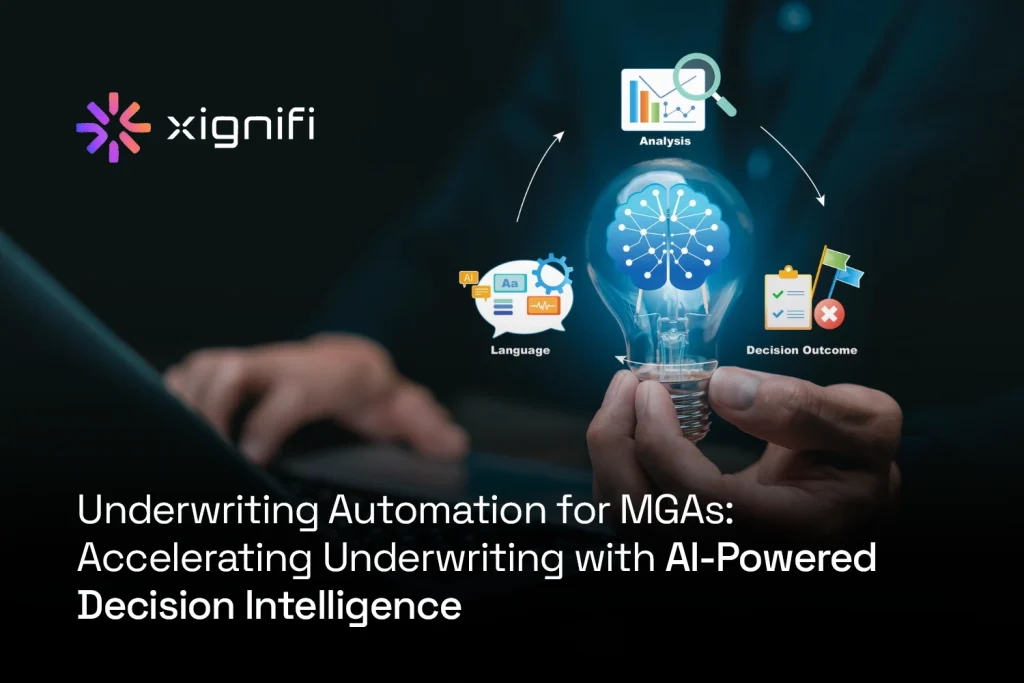
Underwriting Automation for MGAs: Accelerating Underwriting with AI-Powered Decision Intelligence Managing general agents in insurance operate in a strange middle ground. You carry the underwriting authority of a carrier without always carrying the systems, staffing, or infrastructure of one. That gap is where most MGA operational pain actually lives, and it’s exactly the gap Xignifi’s underwriting automation was built to close. Priya Mehta Head of Insurance Solutions, Xignifi This isn’t a generic case for “adding AI” to your underwriting desk. It’s a look at the specific problems MGAs run into because of how delegated authority works, and how Xignifi’s agents address each one directly. Why MGAs Need Insurance Underwriting Software Built for Delegated Authority A carrier’s underwriting team usually has scale on its side, dedicated ops staff, in-house compliance, and systems built and maintained specifically for their book of business. An MGA doesn’t always have that luxury. You’re underwriting on someone else’s paper, which means every submission carries two obligations at once: get the risk right, and prove to the carrier that you got it right. That second obligation is where generic tools start to fall short. Insurance underwriting software built for carriers often assumes a single set of guidelines and a single audit relationship. An MGA usually manages several, different binding authority terms, different reporting requirements, sometimes different appetite across multiple carrier partners on the same book. Xignifi was built with that reality in mind, rather than assuming a single carrier’s rulebook is the only one that matters. The Real Cost of Underwriting Without Insurance Workflow Automation A typical MGA underwriting desk without workflow automation runs a version of this process: a broker submission arrives as a PDF or scanned packet, someone manually keys the applicant, property, or risk details into an underwriting system, a separate person cross-checks it against the carrier’s binding authority guidelines, and a third step routes anything unusual to a senior underwriter for sign-off. Each handoff adds delay. Each manual entry adds a chance for error. And at renewal or audit time, reconstructing why a decision was made becomes its own project, because the reasoning lived in someone’s head or an email thread, not in a system of record. Three consequences show up consistently in MGA operations running this way. Submission-to-bind cycles stretch out, because low-risk applications wait in the same queue as complex ones, and brokers notice, sending repeat volume wherever the response is fastest. Underwriting criteria drift, because without a system enforcing consistency, different underwriters, or the same underwriter on different days, can apply carrier guidelines slightly differently, which is exactly what carrier audits are designed to catch. And underwriting capacity gets absorbed by low-value work, with underwriters spending a large share of their week on data entry and document review instead of the judgment calls that actually require their expertise. What Automated Underwriting Actually Changes for MGA Teams Automated underwriting doesn’t mean removing underwriters from the process. It means removing the parts of the process that never needed a person in the first place, so the people you do have are spending their time on risk, not re-keying. Inside Xignifi, that runs through a set of purpose-built agents working together. Insurance Document Automation Solves the Intake Problem First Broker submissions, policy declarations, and supporting documents arrive in mixed formats, PDFs, scanned images, sometimes structured data feeds. Xignifi’s Document Intelligence Agent extracts that information automatically into a consistent, structured record, named insured, policy terms, payment schedule, credit references, instead of a person retyping it field by field into an underwriting system. Document Classification Agent Sorts Submissions Before an Underwriter Ever Sees Them Before extraction can happen accurately, the system needs to know what it’s looking at. As part of that same intake step, Xignifi recognizes whether an incoming file is an application, a loss run, an inspection report, or a financial statement, and routes the right data fields from each into the underwriting record automatically, without a person doing that sorting by hand. Automated Underwriting Turns Structured Data Into a Risk Decision Once the data is structured, Xignifi’s Credit & Risk Scoring Agent evaluates it against defined risk criteria and, where relevant, external data sources, credit information, loss history, property or exposure data, returning a risk score and the reasoning behind it. The Underwriting Decision Agent then orchestrates the outcome: straightforward, low-risk submissions that clear defined thresholds move straight toward approval, while anything borderline or high-risk routes to a human underwriter with a pre-built case summary instead of a raw document to dig through. Running alongside this, the Compliance Validation Agent checks carrier binding authority guidelines and any relevant state-specific requirements before an application can move to bind, while the Audit & Reporting Agent logs every step of the decision automatically, often the single most valuable output for an MGA’s relationship with its carriers. Where Insurance Workflow Automation Pays Off for MGAs MGAs that move from manual processes to Xignifi’s connected underwriting workflow typically see change in a small number of specific places: submission-to-bind time drops because low-risk applications no longer wait behind complex ones in the same queue; straight-through processing rates rise as a defined share of submissions clear automatically without losing underwriter oversight on the cases that need it; and audit readiness improves because the decision trail is captured automatically instead of reconstructed after the fact. None of this requires replacing the underwriting team or the carrier relationship it sits inside, it changes what the team spends its time on. Frequently Asked Questions Is AI replacing underwriting? No. AI handles document extraction, data structuring, and initial risk scoring for straightforward cases, while routing complex submissions to a human underwriter with the risk factors already summarized. The judgment call stays with the underwriter. What are the four main types of underwriting? Insurance underwriting, loan underwriting, securities underwriting, and forensic underwriting. MGAs operate within insurance underwriting, typically under a carrier’s delegated binding authority. What is an automated underwriting system? Software that evaluates applications against defined risk criteria and data sources to approve, decline, or refer a case for manual review, with minimal manual work on straightforward submissions. How does underwriting automation improve compliance for MGAs? By checking carrier binding authority and regulatory requirements automatically before bind, and logging the reasoning behind every decision, so an audit relies on a system record instead of someone’s memory of why a case was approved. Does underwriting automation replace an MGA’s existing systems?
How Much Is Unplanned Failure Really Costing Your Field Service Operation?
How Much Is Unplanned Failure Really Costing Your Field Service Operation? Most field service organizations track uptime, response times, and SLA adherence with precision. What they usually struggle to quantify is the full financial hit of unplanned failure. Abhayakumar K Technical Project Manager When a critical asset breaks down unexpectedly, the visible cost is the repair. The less visible cost is the “chaos tax” it triggers—emergency dispatch, technician rescheduling, parts expediting, contractual penalties, and customer dissatisfaction. These ripple effects compound quietly across the year, but because they aren’t often consolidated into a single financial view, they stay hidden. The result? Reactive maintenance is treated as an operational headache rather than a strategic margin issue. That is where the business case for Predictive Failure Modeling begins. Reactive maintenance is more expensive than it looks On paper, a reactive incident seems manageable. A technician is dispatched, the part is replaced, and the job is closed. But the economics rarely stop there. Emergency work usually carries higher labor costs. Overtime increases. Previously scheduled preventive work gets deferred, and backlogs start to grow. In SLA-driven industries like utilities or telecom, you’re looking at performance credits or penalties. Even when you avoid the fine, customer confidence erodes every time an outage becomes “frequent.” When you multiply that across hundreds of incidents, the financial exposure is massive. Yet, many organizations lack a model that connects reactive volume to the total cost impact. Without that visibility, investing in predictive capabilities feels optional rather than essential. Why Traditional Detection is Failing The problem is that traditional analytics are “task driven.” They check if a field is filled or if a signature exists, but they don’t understand the context. They can’t “see” the subtle digital fingerprints that suggest a document was tampered with or entirely fabricated by AI. In an era where a “perfect” fraudulent document can be generated in seconds, simply “checking the boxes” is no longer a security strategy. It’s a liability. The limits of “Checking the Box” Most teams have already moved from purely reactive work to preventive schedules. Assets are inspected at defined intervals. Components are replaced based on a calendar. This reduces some risk, sure. However, preventive strategies assume every asset behaves the same way. In reality, equipment performance varies based on the environment, load patterns, and—most importantly—the subtle warning signals embedded in your service records. Some assets are maintained too early (wasting money), while others fail between cycles anyway. Predictive Failure Modeling addresses this gap. It shifts the decision-making from a calendar-based guess to a probability-based priority. The commercial logic of the model At its core, predictive modeling estimates the likelihood that a specific asset will fail within a defined window. It doesn’t try to eliminate failure entirely; it concentrates your attention where the risk is statistically highest. That change in priority materially changes your cost structure. If you service high-risk assets earlier and stop over-maintaining low-risk ones, you reduce emergency dispatches and stabilize your technicians’ schedules. The financial case hinges on a simple question: What proportion of our current reactive cost is avoidable through earlier intervention? Building the ROI narrative (without overcomplicating it) An ROI conversation doesn’t require complex modeling at the start. It just needs three inputs: Annual volume of reactive incidents. Average cost per incident (including the disruption). A realistic estimate of the avoidable percentage. If an organization has 1,000 reactive incidents a year, even a 15–20% reduction could justify a predictive investment almost immediately. The key isn’t whether it’s technically feasible—in most modern environments, the historical work orders and maintenance logs provide a rich dataset.The real question is whether you’ve translated that data into forward-looking risk intelligence. From operational data to financial leverage Field service organizations generate vast amounts of data. Technician notes, fault codes, and part replacement histories often contain the early indicators of failure. However, these signals usually stay buried in historical records. Predictive Failure Modeling becomes powerful when it connects these signals to measurable risk reduction. It reframes maintenance from a cost center to a margin-protection strategy. The strategic conversation leaders should be having The discussion shouldn’t start with algorithms. It should start with exposure: How much controllable margin is being absorbed by unplanned failure? How stable is our SLA performance under reactive strain? What is the annual cost volatility of our emergency response? Until these questions are quantified, predictive investment remains theoretical. Once they are quantified, it becomes a commercial decision. In our upcoming session on Predictive Failure Modeling for Field Service Organizations, we’ll explore how to structure this ROI conversation, what realistic impact looks like in asset-heavy environments, and how leaders can evaluate their readiness without overcommitting to technology prematurely. The real opportunity isn’t eliminating failure—it’s reducing the ones we can avoid and reclaiming your margin in the process. Talk to Xignifi See what document-aware agentic AI looks like inside your claims stack. Request a walkthrough
Document-Based Fraud in 2026: Why Traditional Verification is Failing

Document-Based Fraud in 2026: Why Traditional Verification is Failing Most organizations believe they have a handle on their security. They’ve invested in firewalls, encrypted their emails, and trained staff on phishing attempts. But there is a massive, quiet leak in the hull of the ship that many are completely ignoring. Vipul Tiwari VP Most organizations believe they have a handle on their security. They’ve invested in firewalls, encrypted their emails, and trained staff on phishing attempts. But there is a massive, quiet leak in the hull of the ship that many are completely ignoring. Recent data reveals a staggering reality: 40% of fraud today is document-based. When we talk about fraud, we often think of sophisticated hackers or complex wire transfer schemes. However, the most effective way for bad actors to bypass your defenses isn’t through a line of code—it’s through a simple PDF. The Weaponization of the “Standard” Document In the video clip below, Suraj Arukil, CEO & Co-Founder of Docketry discusses why this trend is accelerating. Historically, a “document” was a static piece of information. Today, it is a Trojan horse. Whether it’s an altered invoice, a forged certificate, or a manipulated bill of lading, these documents are the lifeblood of business operations. Because we must trust them to keep moving, they become the perfect disguise for fraud. Why Traditional Detection is Failing The problem is that traditional analytics are “task driven.” They check if a field is filled or if a signature exists, but they don’t understand the context. They can’t “see” the subtle digital fingerprints that suggest a document was tampered with or entirely fabricated by AI. In an era where a “perfect” fraudulent document can be generated in seconds, simply “checking the boxes” is no longer a security strategy. It’s a liability. 3 Red Flags: What Your Team is Missing in Document Verification To combat the 40%, you must look beyond the surface level. Here are the three most common indicators that a document isn’t what it claims to be: Metadata Mismatches: A PDF might look like a scan from a reputable supplier, but the metadata (the digital footprint behind the file) reveals it was created in a free online editor two hours ago. If the “Date Created” doesn’t match the “Date Issued,” proceed with caution. Font and Layer Inconsistencies: Modern AI-generated fraud often struggles with “layering.” When an attacker modifies a price or a bank account number on an existing invoice, they often leave behind subtle misalignments or font weight changes that a standard OCR (Optical Character Recognition) tool will ignore, but a specialized system will catch. Contextual Anomalies: This is the “big picture.” Does this invoice match the historical pricing for this vendor? Is the language used consistent with their previous 50 communications? Fraudsters can fake a logo, but they struggle to fake a long-term behavioral pattern. Moving from Defense to Intelligence The goal shouldn’t just be “detecting fraud”; it should be Organizational Intelligence.Organizations are now moving from document processing to document intelligence, where verification happens automatically within workflows. At Docketry, we built ExtractIQ to serve as the “brain” for your document workflows. We aren’t just extracting data; we are verifying authenticity and cross-referencing insights across your entire history. When you automate the “eyes” of your organization, you don’t just save time; you close the door on the 40% of fraud that thrives in the shadows of manual processing. Key Takeaways Document-based fraud is growing quickly, and it rarely looks suspicious at first glance. Altered invoices, certificates, and everyday operational documents have become one of the easiest ways for fraud to enter an organization. Traditional verification methods were designed for a different era. Checking fields or validating formats is no longer enough when fraudulent documents can be generated or modified to look perfectly legitimate. Today, fraud often hides inside normal business workflows. Because teams need to process documents quickly, harmful changes can slip through unnoticed. Small signals — like unusual metadata, subtle formatting changes, or inconsistencies with past transactions — are often early warning signs. These are easy to miss when verification relies on manual review or basic OCR tools. AI-driven document intelligence changes the approach from reacting after fraud happens to continuously verifying documents as they move through workflows, helping organizations catch risks earlier and with greater confidence. Talk to Xignifi See what document-aware agentic AI looks like inside your claims stack. Request a walkthrough
What CISOs Really Look for Before Approving AI Systems
What CISOs Really Look for Before Approving AI Systems Over the past year, we’ve noticed something interesting in almost every enterprise conversation around AI. The excitement rarely comes from the security team. But the final decision almost always does. Rakesh Ravindran Chief Marketing Officer At Docketry, we work closely with banks, financial institutions, and operations teams trying to operationalise AI across document-heavy workflows. And while business leaders often ask how fast AI can be deployed, CISOs tend to ask a very different question: “What risk does this introduce into my organisation?” That question has quietly become the defining checkpoint for enterprise AI adoption. Because today, AI approval isn’t about capability. It’s about trust. AI Isn’t Just Software Anymore Traditional enterprise software followed predictable rules. Inputs were structured, outcomes were deterministic, and security boundaries were relatively clear. AI changes that equation.AI systems interpret messy data, learn patterns, and influence decisions that previously required human judgment. When documents, financial records, compliance workflows, or customer data enter an AI system, the technology effectively becomes part of the organisation’s decision infrastructure.From a CISO’s perspective, that expands the attack surface overnight. What we’ve learned is simple:CISOs are not resisting AI — they’re trying to make sure AI behaves like enterprise infrastructure, not experimentation. The First Conversation Is Always About Data Almost every serious discussion begins here.Not models. Not accuracy. Not automation. Data control.Security leaders want clarity on where enterprise data travels, how it is processed, and whether it ever leaves controlled environments. This becomes especially critical in document intelligence systems like ours, where sensitive operational documents move continuously through AI workflows. In our experience, confidence increases dramatically when AI platforms demonstrate clear boundaries: Data isolation, Controlled access, Audit visibility, Strict handling policies. If data governance feels uncertain, approval rarely moves forward — regardless of how powerful the AI may be. Explainability Matters More Than Intelligence One misconception we often see is that enterprises primarily evaluate AI performance.In reality, CISOs care just as much about understanding decisions as achieving them.If an AI system flags fraud, validates a document, or triggers an operational action, security teams need to know why it happened. Black-box automation creates organisational risk.Enterprise AI works best when decisions remain traceable — when teams can review outcomes, audit workflows, and step in when needed. In many deployments, the presence of human validation isn’t seen as friction; it’s seen as reassurance.AI adoption accelerates when accountability remains intact. Governance Is No Longer Optional Another shift we’ve observed: AI governance discussions now happen much earlier than they used to.A few years ago, governance followed deployment. Today, it precedes it.CISOs increasingly evaluate whether an AI system already fits within existing security and compliance frameworks before it ever goes live. Questions around monitoring, lifecycle control, and audit readiness appear early in procurement conversations. This reflects a broader reality — organisations are preparing for a world where AI systems will be audited just like financial systems or infrastructure platforms.The expectation is clear: AI must arrive enterprise-ready. Vendor Trust Has Become a Security Decision Enterprise AI rarely operates alone. Behind most solutions sit models, cloud environments, APIs, and multiple technology layers.Which means CISOs aren’t only evaluating the product in front of them — they’re evaluating the ecosystem behind it.We’ve seen approvals move faster when vendors are transparent about architecture, dependencies, and operational safeguards. Security teams want visibility into how systems are built, not just what they promise.In many cases, vendor maturity becomes a stronger signal than feature depth. Control Over Autonomy With the rise of agentic AI, one concern surfaces consistently: control.Automation is valuable. Unbounded automation is not.Security leaders want assurance that AI operates within defined permissions, escalates uncertainty, and respects organisational policies. The most successful enterprise deployments balance autonomy with containment — enabling efficiency without surrendering oversight.Interestingly, this is where AI begins to gain real internal support. When CISOs see guardrails working effectively, they often become advocates rather than gatekeepers. The Real Approval Criteria: Risk Reduction Perhaps the biggest insight from working with enterprise security teams is this:CISOs rarely approve AI because it is innovative.They approve it when it reduces overall organisational risk.If AI improves auditability, detects anomalies earlier, standardises decision-making, or removes manual vulnerabilities, the conversation shifts completely. AI stops looking like a new threat and starts looking like a control mechanism.That’s when adoption accelerates. Security Is Becoming the Enabler of Enterprise AI One of the most notable changes we’re seeing across industries is the evolving role of the CISO.Security leaders are no longer just protecting systems from change — they are shaping how change happens safely.The enterprises successfully scaling AI today are not the ones moving fastest in experimentation, but the ones designing AI systems that security teams can confidently stand behind.From our perspective at Docketry, enterprise AI succeeds when security, operations, and automation evolve together — not independently.Because in large organisations, AI doesn’t enter production when technology is ready.It enters production when trust is established. Final Thought As AI becomes embedded into operational workflows, the companies that win adoption won’t necessarily have the most advanced models.They’ll have the systems that enterprises — and their CISOs — trust to run critical work.And increasingly, that trust is becoming the true foundation of enterprise AI. Talk to Xignifi See what document-aware agentic AI looks like inside your claims stack. Request a walkthrough
Task-Based AI

Why “Task-Based AI” Is Already Obsolete In the evolving landscape of artificial intelligence (AI), we’re witnessing a significant shift from the traditional, simplistic task-based AI systems to more sophisticated, outcome-driven agentic systems. While earlier AI assistants were limited to answering isolated queries, today’s AI is rapidly becoming more autonomous, able to execute multi-step workflows across various applications. Jojith R C T O This new era of AI is pushing beyond the boundaries of simple chatbots and rigid task-based processes, ushering in the age of agentic workflows that can adapt, automate, and deliver tangible outcomes across the digital ecosystem. In this blog, we’ll dive into why task-based AI is becoming obsolete, and explore how autonomous AI, hyper-automation, and robotic process automation (RPA) are revolutionizing business processes in the context of digital transformation. The Fall of Task-Based AI Task-based AI, as the name suggests, was designed to perform discrete tasks. These systems were capable of answering questions, providing recommendations, or solving basic problems within predefined rules.While these AI systems were a breakthrough in automation, they remained fairly limited in scope. Their functionality typically stopped at the completion of a specific task, like answering a question or executing a single action. Why Traditional Detection is Failing The problem is that traditional analytics are “task driven.” They check if a field is filled or if a signature exists, but they don’t understand the context. They can’t “see” the subtle digital fingerprints that suggest a document was tampered with or entirely fabricated by AI. However, as organizations demanded more complex solutions that could interact across various tools, applications, and platforms, task-based AI quickly became a bottleneck. These systems lacked the capability to process multi-step workflows, handle interdependencies between tasks, or adjust to unforeseen changes in the workflow. For instance, while chatbots can help customers with FAQs, they often fall short when faced with more complex queries that require access to multiple systems, data sources, or follow-up actions. This highlights a fundamental flaw in the task-based model: it cannot provide outcomes or make the kinds of decisions that organizations need in the rapidly evolving digital economy. This limitation has led to the rise of autonomous AI, i.e. systems capable of taking action and delivering results, not just data. Enter Multi-Step Execution and Agentic AI The new frontier of AI lies in agentic workflows, which in essence means – AI systems capable of navigating multi-step tasks, coordinating different applications, and delivering outcomes, not just responses. Unlike simple task-based AI, agentic AI can understand and execute workflows that span multiple applications, from managing emails to triggering customer follow-ups, automating billing processes, and more. These systems are designed to handle complex, dynamic environments where tasks need to be executed in a sequence that may involve decision-making, recalibrations, and cross-platform interactions. For instance, a sophisticated AI agent might be tasked with managing a customer journey that begins with an initial inquiry, continues with a personalized email response, and culminates in a sales representative reaching out, all while tracking every step of the process and optimizing it as it goes. Rather than answering a question, they execute a process that leads to a final outcome. This makes them ideal for industries such as finance, healthcare, retail, and more, where seamless, automated workflows are essential for both efficiency and customer satisfaction. Why Task-Based AI Can’t Keep Up The need for multi-step execution becomes particularly evident when you consider the following gaps in task-based AI: Limited Contextual Understanding: Task-based AI systems often operate in silos, unable to understand or make decisions based on the broader context. They may complete individual tasks like responding to an email, but they cannot connect those actions to larger business processes or customer journeys. Lack of Adaptability: Task-based AI systems follow predefined paths, making them inflexible in dynamic environments. If something goes wrong or if a new task emerges, these systems are often unable to adapt and adjust. In contrast, agentic AI is designed to learn and adjust in real-time, enabling them to make decisions on the fly and interact with new systems seamlessly. Inability to Drive Outcomes: The most significant drawback of task-based AI is its inability to drive real-world business outcomes. While these systems are effective at carrying out individual tasks, they do not contribute to larger business goals such as improving sales, enhancing customer experience, or streamlining operations. Agentic systems, however, are built with these outcomes in mind and work towards them. The Rise of Hyperautomation and Robotic Process Automation (RPA) At the heart of this transformation lies hyper-automation, a concept that goes beyond automating individual tasks to creating fully automated workflows across an organization. Hyper-automation integrates a wide array of advanced technologies, including RPA, AI, machine learning (ML), and natural language processing (NLP), into a seamless process that allows for end-to-end automation. While RPA focuses on automating rule-based tasks (such as data entry, invoice processing, or employee onboarding), it still falls short in terms of adaptability and intelligence. When integrated with autonomous AI, however, RPA systems evolve into more robust solutions that can handle decision-making and cross-application workflows. RPA vs AI has been a critical debate in the industry, with RPA often being seen as a tool for automating repetitive tasks, while AI enables systems to perform tasks requiring judgment, problem-solving, and learning. However, as AI continues to evolve, AI-driven RPA systems are becoming the preferred choice for enterprises. These systems combine the rule-based automation of RPA with the decision-making capabilities of AI, resulting in more intelligent, adaptive, and scalable processes. The Role of AI Agents in Digital Transformation The shift to agentic AI is central to digital transformation. In today’s digital economy, businesses are increasingly relying on AI to improve operational efficiency, enhance customer experience, and drive innovation. By moving away from task-based AI and adopting agentic workflows, companies are enabling themselves to operate at scale, respond to customer needs in real-time, and make data-driven decisions more quickly than ever before. Moreover, agentic AI is democratizing technology, making advanced capabilities accessible to a
Building the Critical Governance Layer for Enterprise AI Platforms

Building the Critical Governance Layer for Enterprise AI Platforms In today’s rapidly evolving digital landscape, autonomous AI systems are becoming essential for enterprises looking to streamline operations, improve decision-making, and drive innovation. However, with great autonomy comes great responsibility. Suraj Arukil CEO Enterprises adopting agentic workflows must implement a robust Governance Layer to ensure that their AI systems are not only effective but also ethical, transparent, and secure. The Governance Layer is the critical component that ensures AI systems are aligned with business objectives, comply with regulations, and maintain trust. In this blog, we’ll explore the importance of the AI governance framework, policy enforcement, and real-time audit trails, and how they can be integrated into your enterprise AI infrastructure to foster responsible AI usage. What is the Governance Layer? The Governance Layer refers to the policies, procedures, and systems that oversee the operations of AI within an enterprise. This layer ensures that AI systems are compliant with laws, transparent in decision-making, and aligned with organizational goals. In essence, it functions as a control mechanism to monitor AI actions, enforce ethical standards, and maintain data privacy and security. For example, imagine a financial services company using AI to assess loan applications. Without a governance framework, the AI system may inadvertently make biased decisions based on historical data, leading to unfair outcomes. A proper Governance Layer ensures that the AI remains compliant with fairness guidelines, enforces non-discriminatory lending policies, and provides clear reasoning for its decisions. Building an Effective AI Governance Framework A successful AI governance framework is made up of several key components, including policy enforcement, data privacy, and AI audit capabilities. These elements ensure that AI systems are governed responsibly and can be trusted to make decisions that align with an organization’s values. Policy Enforcement: AI policies define how AI models are trained, how data is handled, and what ethical guidelines must be followed. For example, in healthcare, an AI system that recommends treatment plans must adhere to medical ethics and comply with HIPAA for patient privacy. Without policy enforcement, AI systems may unintentionally violate these standards, leading to legal consequences. Real-Time Audit Trails: Audit trails are logs that track the AI’s decision-making process. They provide a historical record of how and why decisions were made, offering transparency and accountability. For instance, in e-commerce, if an AI system recommends products to a user, an audit trail can show how past purchases, search history, and other data influenced the recommendation, which can be reviewed for bias or inaccuracies. Reasoning Transparency: AI systems must explain the rationale behind their decisions, especially in high-stakes sectors like finance or healthcare. This allows decision-makers to understand how AI arrives at its conclusions and provides an opportunity to intervene if necessary. For example, a loan approval AI should not only say whether a loan is approved but also provide a clear explanation, like “approved due to strong credit score” or “denied due to lack of sufficient income verification.” The Importance of AI Security and Data Privacy With the increasing reliance on AI, securing AI systems and protecting the data they use has never been more critical. AI security encompasses both the protection of the AI models themselves and the safeguarding of sensitive data that fuels these systems. Data privacy is another key concern, as AI systems often handle personal or confidential data that must be protected in compliance with laws like the GDPR. For example, a healthcare AI system that analyzes medical records to predict patient outcomes must ensure that all data is anonymized and stored securely, protecting patient privacy while still allowing the AI to function effectively. Trust in AI and the Need for Responsible AI One of the biggest challenges with AI adoption is ensuring that stakeholders, from customers to regulators, can trust AI systems. Trust in AI is built on transparency, accountability, and compliance with ethical standards. Let’s take a closer look at an example where the AI governance framework plays a crucial role: Example: AI in Recruitment A global recruitment firm uses AI to screen resumes and assess candidates. Without proper governance, this AI could inadvertently develop biases, such as favoring certain demographic groups over others based on historical data. The company implements a Governance Layer that includes: Policy Enforcement: Clear policies on fairness and inclusivity that ensure AI considers all candidates equally. AI Audit: Regular audits that check for bias in the decision-making process. Reasoning Transparency: AI is required to explain why it recommends a particular candidate, offering insights such as “Recommended due to skills match and work experience in the tech industry.” Key Components of a Robust Governance Layer To ensure the effectiveness of the Governance Layer, here are the key components enterprises need to focus on: Data Integrity and Quality Control: AI systems are only as good as the data they are trained on. Ensuring data is accurate, consistent, and free of bias is crucial for maintaining a reliable AI system. Ethical Guidelines and Compliance: As AI systems make more autonomous decisions, it is important to ensure they operate within legal and ethical boundaries. For example, AI in healthcare must comply with medical guidelines and patient privacy laws. AI Model Explainability: Businesses must ensure that their AI models can explain their decisions in a human-understandable way. For instance, a banking AI should be able to justify why a loan was rejected, helping customers understand the reasoning and fostering trust in the system. Continuous Monitoring and Feedback: AI governance should not be a one-time setup; it should include ongoing monitoring and adjustments to ensure compliance and accountability are maintained over time. Conclusion As enterprises continue to integrate autonomous AI systems into their operations, the Governance Layer will become increasingly crucial. Without a solid governance framework, organizations risk compromising data privacy, AI security, and ultimately, trust in AI. By enforcing policy compliance, ensuring real-time audit trails, and maintaining reasoning transparency, businesses can create AI systems that are not only effective but also responsible, ethical, and aligned with organizational values. Building
Optimizing U.S. Claims Infrastructure

Optimizing U.S. Claims Infrastructure The case for document-aware agentic AI inside the modern claims stack, and why carriers chasing combined-ratio gains can’t get there with bolt-on OCR alone. Abhayakumar K Technical Project Manager U.S. claims operations have quietly become one of the most expensive coordination problems in financial services. A single auto or property claim can touch a dozen systems, three or four humans, and a paper trail that spans estimates, invoices, medical records, photos, and adjuster notes, most of it unstructured, most of it duplicated. The state of U.S. claims Carriers have spent the last decade layering automation on top of legacy core systems: rules engines, RPA bots, document classifiers, fraud scoring. Each one made a narrow slice of the process faster, and made the overall workflow harder to reason about. The result is a claims stack that looks modern from the outside and still runs on triage spreadsheets on the inside. The numbers tell the same story. First-notice-of-loss to settlement cycle times have barely moved in five years. Adjuster attrition is climbing. Indemnity leakage caused by inconsistent decisions is now a board-level conversation at most top-25 carriers. Where the friction actually lives If you watch a senior adjuster work for a day, the bottleneck isn’t decisions. It’s the work that surrounds the decisions: pulling the right document out of a 60-page PDF, reconciling a body-shop estimate against a coverage form, deciding whether a medical bill code is in or out of scope. Documents arrive in a dozen formats and have to be normalized before anything else happens. Coverage interpretation lives in policy language that doesn’t match how systems are modeled. Fraud signals are spread across siloed tools that don’t share context. Every handoff between systems requires a human to re-state what just happened. Agentic AI inside the claims stack Document-aware agentic AI changes the shape of this problem. Instead of a pipeline of point tools, you get a small set of agents that can read the file, understand the coverage, follow the SOP, and stop to ask a human only when the decision is genuinely ambiguous. “The right unit of automation in claims is no longer a task. It is a decision, with the evidence, the policy, and the rationale attached.” A practical blueprint The carriers getting real lift don’t rip and replace. They wrap their existing core with an agentic decision layer: ingest, understand, decide, explain. Each agent has a narrow remit, a clear policy boundary, and an auditable trail. Start with a single, high-volume claim type where indemnity leakage is measurable. Instrument the existing workflow before changing it, you cannot optimize what you cannot see. Deploy agents alongside adjusters, not behind them. Adoption follows trust. Make every automated decision explainable in the language of the policy. Outcomes that move the combined ratio Done right, the wins compound. Cycle times drop because documents stop sitting in queues. Leakage drops because decisions become consistent. Adjuster retention improves because the tedious work disappears. None of it requires a multi-year core replacement — and none of it is achievable with bolt-on OCR alone. Talk to Xignifi See what document-aware agentic AI looks like inside your claims stack. Request a walkthrough