Most insurance quoting software promises faster quotes. Few explain which capabilities actually improve underwriting outcomes.
The difference matters, because underwriting teams don’t need more dashboards. They need fewer manual decisions, cleaner submissions, and faster access to risk insights. A tool that builds a polished quote from messy, half-keyed data just produces bad quotes faster.
This guide is for MGA leaders, chief underwriting officers, and the operations and IT leaders who sit beside them. It separates the AI features that change underwriting economics from the ones that mostly change the demo, and it ends with a scorecard you can take into your next vendor meeting.
TL;DR
- Most quoting platforms automate quote generation but not submission preparation, and the preparation is where the hours go.
- AI submission triage often returns more than better quote templates, because it decides which files deserve an underwriter’s time.
- Productivity improves when software reduces data gathering, not only data entry.
- Decision intelligence (rules, reasoning, and traceable recommendations) matters more than chatbot features.
- The best insurance quoting software works inside your underwriting workflow instead of becoming one more system of record.
- Exception handling sets the real automation rate. Ask what happens to the files the system can’t read.
- Judge vendors on quote turnaround, submissions per underwriter, and referral rate, not on AI accuracy alone.
- Put governance in the buying criteria: audit trails, human-review thresholds, and the vendor diligence regulators expect.
What Is Insurance Quoting Software?
Insurance quoting software takes risk information, applies rating and underwriting rules, and produces a priced quote. The newer, AI-enabled versions also prepare the submission itself: reading documents, checking completeness, and routing files before a quote is ever built.
The category covers a wide range, so it helps to separate the generations.
- Traditional quoting tools are rating engines, comparative raters, and quote templates. Someone types the data in, the system applies the rates, and a quote comes out. They’re fast at the last step and silent on everything before it.
- Modern underwriting platforms wrap more of the workflow: intake, triage, referrals, authority limits, quote, and bind.
- AI-enabled quoting adds the ability to read unstructured submissions, reason about them against your rules, and coordinate the steps between inbox and rater.
Quoting Software vs. Underwriting Platforms: What Each One Does
| Quoting software | Underwriting platform | |
|---|---|---|
| Core job | Price a risk and produce a quote | Manage the risk from submission to bind |
| Where it starts | Once data has been entered | When the submission arrives |
| Handles documents? | Rarely; data is keyed in | Often, with intake and extraction |
| Referrals and authority | Basic, if at all | Built in, with approvals and audit trail |
| Typical blind spot | Everything upstream of the rater | Fit with your existing rater and core system |
The line between the two is blurring, and that’s good news for buyers. Many MGAs don’t need to replace their policy system. They need the layer between the broker’s email and the rater, and that’s where AI has made the biggest difference.
Which AI Features Actually Matter in Insurance Quoting Software?
The most valuable AI capabilities reduce underwriting effort, improve risk visibility, and shorten quote turnaround. Features that only change how the software looks, or that sit outside the underwriting workflow, rarely do any of the three.
The industry’s own priorities point the same way. In the Underwriting Edge 2026 survey of 350 senior commercial underwriters, end-to-end workflow automation (52%) and submission ingestion (48%) top the list of where organizations plan to invest. The same survey, covered by Insurance Business, found inconsistent submission data was named by 44% of underwriters as a top drag.
Which AI Features Actually Matter in Insurance Quoting Software?
Submission triage. The system checks appetite, spots duplicates, scores the file, and routes it to the right desk. It matters because it decides where scarce underwriter time goes. Ask to see the reasons behind each routing decision, and how often underwriters override it.
Document intelligence. This means recognizing what each document is: an ACORD form, a loss run, a statement of values, a cover email. Without it, every packet starts with someone sorting PDFs. Xignifi’s Document Intelligence layer is built around this step.
Data extraction and validation. Reading the values is half the job. The other half is checking them against code lists and against each other. A system that extracts without validating moves errors along faster. Document Extraction and Data Normalization are separate agents on the Xignifi platform for this reason.
Risk summarization. A short, sourced brief of the account: what it does, where the exposures are, what’s missing. It earns its place only if every statement links back to the source page, so an underwriter can trust it in a minute instead of rechecking it for ten.
Workflow orchestration. Coordinating the steps: chasing missing items, calling the rater, assembling the quote, sending it to the broker. This is where hours disappear between tasks, and it’s the focus of Xignifi’s Operational Intelligence layer.
Predictive recommendations. Appetite fit, pricing guidance, likelihood to bind. Useful when explained and tested on your own book, and risky when it’s a score nobody can interrogate.
Decision intelligence. This ties rules, data, reasoning, and approvals into recommendations that carry their evidence with them. Xignifi’s Cognitive Intelligence layer sits here. The practical test: can an underwriter see why the system recommended what it did, and change it?
Which AI Features Are Mostly Marketing Hype?
The features most likely to be hype are the ones that sit beside the underwriting workflow instead of inside it: generic assistants, basic chatbots, standalone content generation, dashboards no one opens, and long feature lists. They aren’t useless, but they rarely change underwriting economics.
Buyers should expect some vendor inflation. Gartner has warned that many vendors engage in “agent washing,” which means rebranding existing products such as AI assistants, robotic process automation, and chatbots without substantial agentic capabilities. The same Gartner analysis predicts more than 40 percent of agentic AI projects could be canceled by the end of 2027 because of rising costs, unclear business value, or inadequate risk controls.
AI Quoting Features That Rarely Move Underwriting Economics
| Feature | Why vendors lead with it | Why it rarely changes the numbers | Ask this instead |
|---|---|---|---|
| Generic AI assistant | Easy to demo, works on any topic | It answers questions but doesn't prepare or route submissions | "What work does it complete without being asked?" |
| Basic chatbot | Familiar and quick to add | Underwriters rarely stop to chat with software mid-file | "Which workflow step does it remove?" |
| Standalone content generation | Drafts emails and summaries on demand | Saves minutes, not hours, and doesn't fix the data behind the content | "Does it draft from validated data, or from whatever it's pasted?" |
| Unused dashboards | Look impressive in a demo | Nobody changes behavior because of a chart | "Who acts on this, and what do they do differently?" |
| Feature overload | Long lists feel like value | Each extra module adds training and integration cost | "Which three features will drive our results?" |
How Does AI Improve the Quote-to-Bind Process?
AI improves quote-to-bind by removing the waiting and re-keying between steps. The underwriter’s actual decision stays in place, and everything around it gets faster and cleaner.
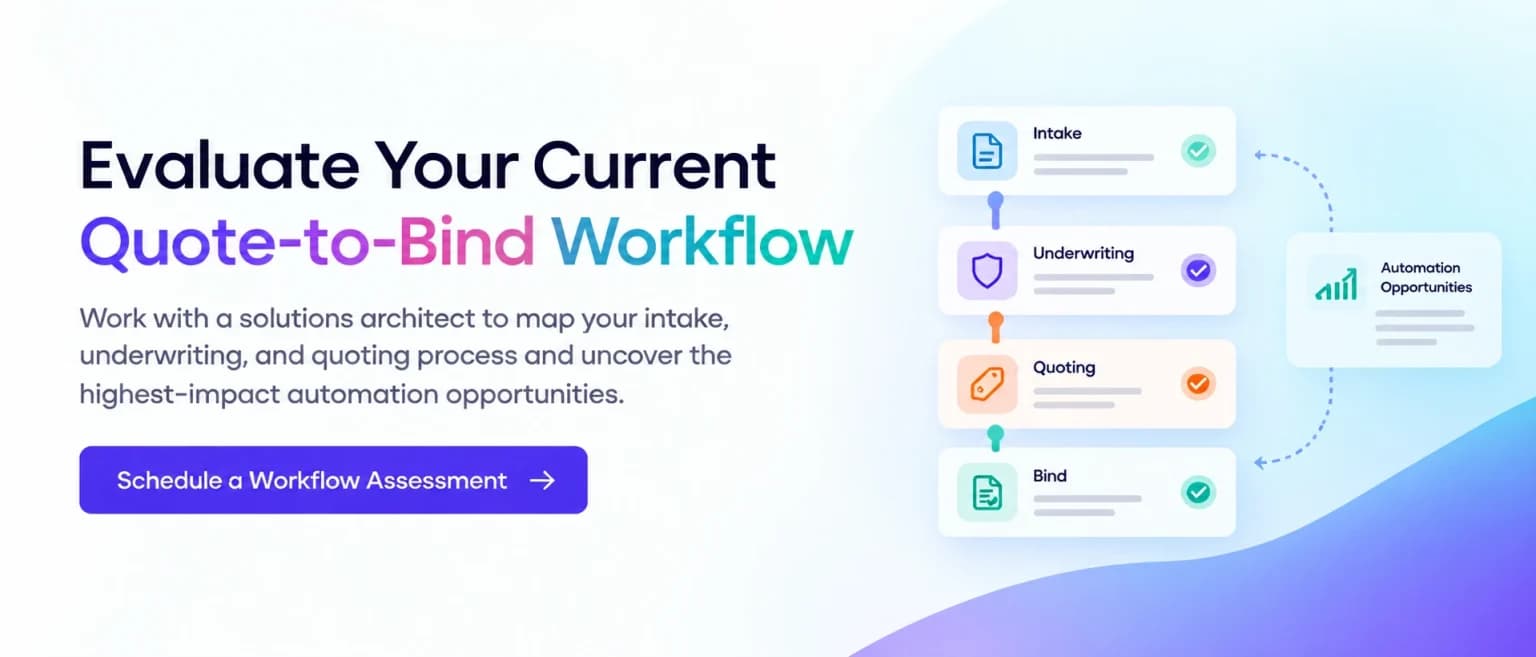
The workflow looks like this:
- 1.Submission received: the system picks up email and portal submissions as they arrive.
- 2.Document classification: each file is identified, so nobody sorts the packet by hand.
- 3.Data extraction: values are read from forms, loss runs, and schedules.
- 4.Validation: values are checked against code lists and each other, and missing items are requested from the broker.
- 5.Risk summarization: a sourced brief of the account is prepared.
- 6.Underwriter review: the underwriter looks at a complete, summarized file instead of a raw packet.
- 7.Quote generation: the rater is called and the quote assembled within authority limits, with referrals for anything outside them.
- 8.Broker delivery: the quote goes out and follow-up is tracked.
Four bottlenecks disappear along the way. The first is the wait before anyone opens the file. The second is retyping the same values into two or three systems. The third is the email loop to chase missing information. The fourth is the quote assembly, which is mostly copying terms into a document.
The underwriter’s judgment is intact at step six. What changes is how much of their day goes to getting there. For a step-by-step look at which parts of this flow can run automatically and which should stay human, see our guide to quote-to-bind automation. On the Xignifi platform, Submission Intake, Completeness Validation, and the Quoting Agent cover steps one, four, and seven, and Submissions Triage handles routing along the way.
What Features Should MGAs Prioritize When Evaluating Insurance Quoting Software?
MGAs should prioritize submission triage, document intelligence, workflow automation, and risk summarization first. These four attack the data-gathering work that fills an underwriter’s day. Predictive analytics and chat features come later.
MGA Feature Prioritization Matrix: Business Impact and Evaluation Priority
| Capability | Business impact | Evaluation priority | How to test it |
|---|---|---|---|
| Submission triage | Very high | Must have | Run 50 recent submissions and review routing reasons and overrides |
| Document intelligence | Very high | Must have | Include your worst scans and unusual attachments |
| Workflow automation | High | Must have | Trace one submission end to end and count manual touches |
| Risk summarization | High | Must have | Have an underwriter verify each statement against the source |
| Predictive analytics | Medium | Nice to have | Back test recommendations against your own bound and declined risks |
| Chatbot features | Low | Low priority | Ask which underwriting step it removes |
Two things set MGAs apart from carriers when they evaluate software. They work under delegated authority, so the audit trail and the authority limits in the tool matter just as much as speed. And they report to their capacity partners, so anything that makes submission data cleaner and reporting easier carries extra weight.
Rank by what your own bottleneck is. If your underwriters lose the most time sorting packets, document intelligence comes first. If good submissions sit unassigned, start with triage.
How Do You Measure ROI From Insurance Quoting Software?
Measure ROI by comparing labor savings, extra quote capacity, and faster turnaround against a baseline you capture before go-live. The calculation is simple. Getting a trustworthy baseline is the harder part.
The three formulas:
- Labor savings = Annual submissions × minutes saved per submission × loaded hourly rate
- Throughput increase = Additional quotes processed × win rate × average premium
- Turnaround improvement = Baseline quote time − future quote time
Here’s an illustrative example for a mid-size MGA. These numbers are hypothetical, so use your own.
- Labor savings: 9,000 submissions a year × 35 minutes saved × $48 an hour is about 5,250 hours, or roughly $252,000.
- Throughput: 450 additional quotes × an 18% win rate × $14,000 average premium comes to about $1.13 million in written premium.
- Turnaround: a baseline of 52 hours cut to 14 hours is a 38-hour improvement.
Read those results with care. Written premium isn’t your revenue. An MGA earns commission and fees on it, so apply your own margin before presenting it to finance. And freed hours become cash only if overtime, temp staffing, or hiring actually falls. Otherwise they’re capacity, which still has value when the team can absorb more business.
MGA Feature Prioritization Matrix: Business Impact and Evaluation Priority
| KPI | How to baseline it | Why it matters |
|---|---|---|
| Quote turnaround time | Submission received to quote issued | The headline speed measure, tied to broker response |
| Submission processing time | Touch time per file before an underwriter sees it | Shows how much admin sits in front of the decision |
| Underwriter productivity | Files handled per underwriter per week | Converts directly into capacity |
| Quote volume per underwriter | Quotes issued per underwriter per month | Shows whether capacity is actually used |
| Straight-through processing rate | Share of submissions needing no manual handling | Reveals the true automation level |
| Broker satisfaction | Broker feedback and response-time bands | Connects speed to retention and hit ratio |
Read straight-through rate alongside your referral and quote-correction rates. It’s easy to push it up by loosening rules, and that’s not progress.
What Questions Should Buyers Ask Vendors?
Ask questions that expose how the software behaves when things go wrong, not how it looks when things go right. Exception handling, integration, and auditability separate real platforms from polished demos.
Vendor Evaluation Checklist: What to Ask and What a Good Answer Sounds Like
| Question | A strong answer sounds like | Red flag |
|---|---|---|
| How is submission data captured? | Email, portals, and shared folders, with every file logged | "Users upload documents" |
| What document types are supported? | ACORD forms, loss runs, SOVs, schedules, and emails, including poor scans | Only clean, standard forms |
| How are exceptions handled? | A review queue showing the source image beside each flagged field | "The AI is very accurate" |
| What percentage of submissions need human review? | A figure from a comparable client, with the definition used | No number, or one with no definition |
| What integrations are available? | Named connectors and APIs for your rater, AMS, and policy system | "We can integrate with anything" |
| How are underwriting decisions audited? | Replayable runs showing inputs, rules applied, and who approved | Logs that show outputs only |
| How is AI governance managed? | A documented program covering model oversight, bias testing, and vendor diligence | A one-line policy statement |
| How long to a first live line of business? | A timeline built on your documents | A platform average |
| How is it priced as volume grows? | A clear per-document, per-file, or tiered model | Pricing that rises sharply after the pilot |
A useful habit: after each answer, ask for a customer in the same line of business who can confirm it.
How Will Insurance Quoting Software Evolve Over the Next Five Years?
Insurance quoting software will likely shift from tools that underwriters operate to agents that prepare work for them, with governance defining how far that goes. Nobody knows the exact pace, so treat what follows as direction, not forecast.
Gartner predicts at least 15 percent of day-to-day work decisions will be made autonomously through agentic AI by 2028, up from none in 2024, and that 33 percent of enterprise software applications will include agentic AI by 2028. Insurance quoting won’t be an exception, though regulated decisions will move more slowly than most.
Six shifts are worth planning for:
- Agentic AI: software that carries a task across several steps and systems, not one that responds to a prompt.
- Autonomous intake: submissions read, checked, completed, and routed without anyone touching them, with people stepping in for exceptions.
- Decision intelligence: recommendations that arrive with their evidence, authority check, and reason codes attached.
- Continuous underwriting: accounts re-assessed as new data arrives, instead of once a year at renewal.
- AI agents supporting underwriters: preparing briefs, drafting broker responses, and flagging what changed since the last review.
- Human-in-the-loop governance: approval gates set by the financial and regulatory weight of each decision.
That last point is where regulators are heading too. The NAIC’s Model Bulletin on the use of AI systems by insurers expects insurers to maintain a written program for AI use and due diligence on third-party AI systems and data. Choose a platform now that can meet those expectations later.
What Are the Risks and Limitations of AI Quoting Software?
The main risks are poor data quality, legacy system constraints, weak change management, and governance gaps. All are manageable if you plan for them, and each can sink a project if you don’t.
- Poor data quality. Automation amplifies whatever it’s fed. When submissions arrive incomplete or inconsistent, the system needs strong validation and a follow-up loop, or it just moves bad data around faster.
- Legacy system constraints. Old rating engines and policy systems can limit how deeply new software connects. Test the full round trip into your rater, not only the extraction.
- Low submission volumes. If you handle a few dozen submissions a month, setup effort may never pay back. A simpler tool or a process fix is often the better answer.
- Change management. Underwriters who don’t trust the output will redo the work by hand. Involve them early, make overrides easy, and show the reasoning behind each recommendation.
- AI governance requirements. Adoption of the NAIC AI bulletin is moving state by state, and Quarles’ tracker counted 24 states as of March 2025. The NAIC Insurance Data Security Model Law also requires licensed entities to maintain an information security program and to oversee their third-party service providers, which includes software vendors.
- Vendor lock-in. Ask how you’d export your rules, data, and audit history if you left. Platforms that keep your configuration in a proprietary format make switching expensive.
AI isn’t always the answer. If your guidelines change every few weeks, or your risks are highly bespoke, fix the process first. Software can’t automate rules that don’t exist yet.
What Should You Take Into Your Next Vendor Demo?
Take your own files, your authority matrix, and one pointed question about exceptions. Those three things tell you more than any feature walkthrough.
Bring 50 recent submissions, including the messy ones, and ask the vendor to run them cold. Bring your authority limits and referral rules, and ask where they live in the tool and who can change them. Then ask what happens to a file the system can’t read. How the vendor answers that third question usually tells you whether you’re looking at a platform or a presentation.
If you also baseline your quote turnaround, touches per submission, and straight-through rate before the demo, you can hold every vendor to the same standard afterward. That’s the difference between buying features and buying results.
See Submission Triage Working on Real Files
Watch how Xignifi routes and prepares submissions before they reach an underwriter’s desk.
Explore Submissions TriageFrequently Asked Questions About Insurance Quoting Software
It's software that takes risk information, applies rating and underwriting rules, and produces a priced quote. Modern AI-enabled versions also read documents, validate data, and route submissions before the quote is built. The goal is to cut manual work between the broker's email and the rater.
Buy the Outcome, Not the Feature List
Every insurance quoting software vendor can show you a longer feature list. Very few can show you how those features reduce quote turnaround times, increase submissions processed per underwriter, or improve decision quality.
The platforms that create real underwriting value are the ones that automate the work before the quote: submission intake, document processing, data validation, risk summarization, and workflow routing. Evaluate software based on measurable operational outcomes, not the number of AI capabilities in a demo. Underwriters don’t need more features. They need fewer manual decisions standing between a submission and a quote.
Xignifi’s agents cover intake, extraction, validation, triage, and quoting as one connected workflow, with every decision logged and every approval gated.
Talk to Xignifi
See What AI-Powered Quoting Could Look Like in Your Operation
Book a personalized assessment to identify where submission triage, document intelligence, and workflow automation can accelerate quote turnaround and improve underwriting productivity.
Request a Personalized Assessment