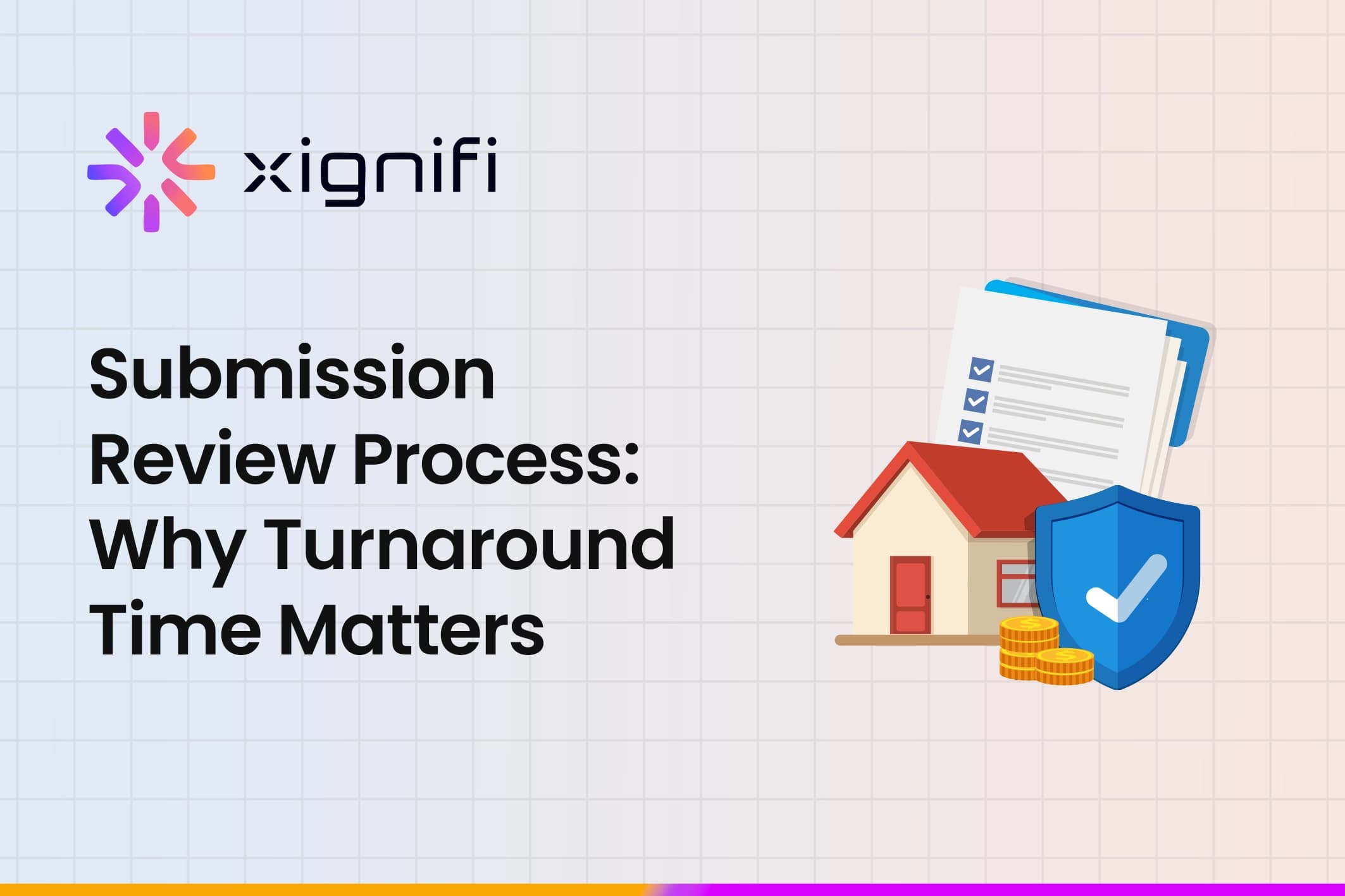
Submission Review Process: Why Turnaround Time Matters
A slow submission review process doesn't just delay a quote. It quietly costs MGAs broker relationships and premium, often without anyone noticing until the pattern is already set.
Want a clear view of your own numbers first?
TL;DR Review time rarely gets lost in underwriting judgment. Most delay happens before a submission ever reaches an underwriter. A slow "yes" reads like a "no" to brokers. They don't wait for an explanation. They quote elsewhere. Most MGAs can't measure this today. "How long does our submission review process take?" rarely has a confident answer. Triage and verification are the real time sinks, not the underwriting decision itself. Speeding up isn't the same as cutting corners. The two get confused more often than they should.
Ask an underwriting manager how long their team takes to review a submission. Most won't have a real number. They'll have a sense of it, maybe a rough average mentioned once in a meeting. An actual figure, tracked by stage, over time? That's rare. This gap matters more than it looks. Slow response times may be costing MGAs broker relationships and premium opportunities right now, quietly, without triggering any obvious alarm. This piece breaks down what a typical submission review process looks like, where the time actually goes, and what it costs an MGA, even when nothing looks broken on the surface.
How Long Does the Submission Review Process Typically Take?
Submission review process length varies by line of business and by MGA. But one pattern holds across most: the biggest delays happen before a submission reaches an underwriter. Intake, verification, and prioritization eat up more time than the actual underwriting decision. There's a measurement gap hiding here too. Most MGAs track time to bind, how long from submission to a finalized policy. Far fewer track time to first response, how long a broker waits to hear anything back. That second number shapes whether a broker keeps sending business. The first one just tells you how long the whole process took, after the fact.
What Causes Underwriting Review Bottlenecks?
Underwriting review bottlenecks form because every submission moves through the queue at roughly the same pace. A strong-fit renewal and a long-shot risk get equal wait time. Nothing sorts the queue by what actually matters.
A few patterns repeat across most MGAs:
1. Incomplete submissions sit in the queue instead of bouncing back right away. A file missing key information doesn't get flagged to the broker immediately, it waits, often for days, until someone notices the gap. 2 Data gets re-keyed by hand. Information from PDFs, emails, and broker portals gets manually typed into rating or policy systems. Every re-key adds delay and a chance for error. 3 There's no real triage logic. A clean, high-value renewal and a speculative new submission enter the same line. Nothing distinguishes them. 4 Nobody can answer "where is this submission right now?" without asking someone. A status check usually means digging through email or a shared folder.
None of these are underwriting problems. They're workflow problems that happen to slow down underwriting.
How Does Broker Response Time Affect an MGA's Business?
Slow broker response time rarely costs an MGA one obvious deal. It costs something harder to see: brokers quietly routing their best business elsewhere, to whoever answers fastest. Brokers work multiple markets at once. They don't wait around for a perfect answer, they go with whoever responds fast and clear. A slow "yes" and an outright "no" often get treated the same way. By the time an MGA finally replies, the broker has already placed the risk somewhere else. This is what makes slow response time dangerous. It doesn't trip an alarm. It shows up months later as a top broker quietly sending fewer submissions than before, and nobody connects it back to how long the team took to respond.
If this sounds like a pattern across your whole book, not just a handful of slow files
about where the bottleneck actually sits.
Traditional Submission Review vs. Xignifi-Enabled Review
The gap between the two isn't about working harder. It's about where time gets spent in the first place.
| Stage | Traditional review | Xignifi-enabled review |
|---|---|---|
| Intake | Manual entry from email/PDF, hours to days | Automated capture via Submission Intake Agent, near-instant |
| Verification | Manual data cross-checks, prone to error | Automated verification via Policy Verification Agent |
| Triage | First-in, first-out queue, no prioritization | Automated prioritization via Submissions Triage Agent |
| Incomplete submissions | Sit unnoticed until manually reviewed | Flagged back to broker automatically |
| Visibility | Status requires asking someone directly | Live status, no manual follow-up needed |
| Underwriter's time | Spent on intake and admin as much as judgment | Spent almost entirely on actual risk decisions |
The shift isn't about replacing underwriting judgment. It's about clearing everything else out of an underwriter's way before a file reaches them.
How Can MGAs Improve Their Insurance Submission Workflow?
Fixing an insurance submission workflow starts with intake and triage, not with a decision about headcount or a new platform.
1. Measure current review time by stage, not just start-to-finish. One average number hides where delay actually lives. 2. Fix incomplete-submission handling first. This is usually the cheapest win available. 3. Separate triage from underwriting. A clear, fast triage step means underwriters spend time only on files that are ready. 4. Build visibility into where a submission sits. If checking status needs a manual look-up, that gap is worth closing first.
None of these require a platform decision on day one. They require knowing where time actually goes, which is exactly what most MGAs are currently missing. If this points to a broader capacity problem, your whole book outpacing what your team can handle, not just individual slow files, our piece on handling more submissions without expanding your underwriting team goes deeper into redesigning the workflow at scale.
What Risks Come With Speeding Up Submission Review?
Speed only helps if accuracy holds. A faster "yes" to a bad risk is worse than a slower one, worth saying plainly before this gets treated as a simple efficiency win. Cutting a step to save time isn't the same as removing a bottleneck. One saves time by working smarter. The other saves time by taking on more risk. MGAs that get this right speed up the parts that don't require judgment, intake, verification, prioritization, while keeping the underwriter's actual review just as rigorous. Visibility into where time goes is what makes that distinction possible. Without it, "let's move faster" too easily turns into "let's skip steps."
The Bottom Line on the Submission Review Process
Submission review process delays usually aren't a speed problem. They're a visibility problem. Once an MGA can see where a file sits and how long each stage actually takes, the fix is usually obvious, and it rarely starts with hiring. The MGAs that get ahead of this don't start by adding headcount or buying a platform outright. They start by measuring where time actually goes. That measurement alone usually points straight at what to fix first. Here's what this comes down to: most MGAs can't say how long their submission review process actually takes, and that blind spot is costing more than anyone realizes. The delays rarely sit where people assume. It's not underwriting judgment that's slow; it's everything that happens before a file ever reaches an underwriter, intake, verification, and a triage process that treats every submission the same, regardless of fit or value. That's a problem because brokers don't wait around to find out why a response is slow. A delayed "yes" and an outright "no" read the same way to someone weighing multiple markets, so the cost shows up quietly, a strong broker relationship sending less business over time, with no single moment that explains why. The good news: this is fixable without a hiring decision. Fixing incomplete-submission handling, separating triage from underwriting, and building real visibility into where a file sits at any given moment solve most of the delay on their own. We're not suggesting you cut corners to move faster, speed only helps if accuracy holds. What we help teams do is clear the noise out of an underwriter's way, not cut the judgment that makes underwriting valuable in the first place. If you don't currently have that visibility, that's where we'd start, not with an automation decision.
Frequently Asked Questions about Submission Review
There's no single benchmark that fits every line of business. But the number that matters most isn't total cycle time, it's time to first response, with Xignifi you can reduce it to 30 minutes from days.
Talk to Xignifi
A focused session with our team that maps exactly where your submission review process loses time, stage by stage, and what's worth fixing first.