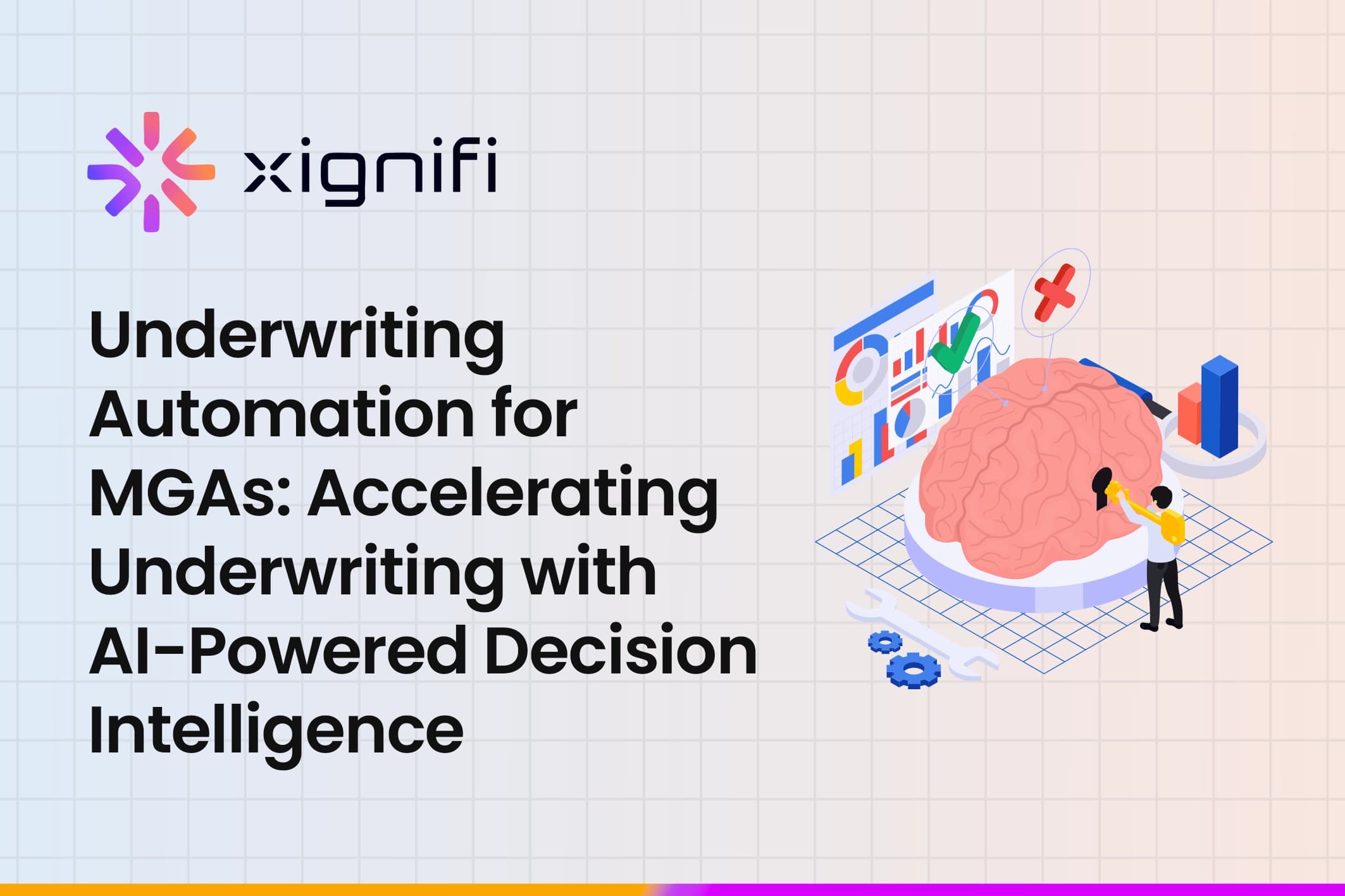
One fine day the submission volume is up, but your team isn't. That gap is the whole problem, and hiring your way out of it isn't working, because experienced underwriters are scarce and slow to onboard, no matter how many requests you open.
Xignifi is a Decision Intelligence platform built for MGAs, specialty carriers, and premium finance providers. It runs the submission lifecycle end-to-end through purpose-built AI agents, with governance and an audit trail built in from day one, not bolted on after a carrier asks for one.
This piece walks through what's actually eating your underwriters' time, what underwriting automation for MGAs looks like once it's live, and how to evaluate a vendor without getting sold a point tool dressed up as a platform.
Why Are MGAs Struggling to Keep Up With Submission Volume?
Submission volume is growing faster than most underwriting teams can absorb, and the manual intake and triage process that worked two years ago is now the choke point, before a single underwriter opens a file. More brokers, more channels, more appetite shifts as the market hardens mean more submissions arriving through more entry points, email attachments, PDFs, portal uploads, all in different formats. Someone has to open every one of them, sort it, and check it's complete, and that someone is usually a person working at the same pace they always have. The real bottleneck isn't underwriting capacity, it's everything that has to happen before that capacity gets used at all.
Why Doesn't Hiring More Underwriters Solve the Capacity Problem?
Hiring adds cost in a straight line, while submission volume is growing faster than a straight line, and experienced underwriting talent is scarce and slow to onboard, so headcount alone can't close a gap that's widening. Every new underwriter takes months to ramp, and that ramp time eats into the capacity of the experienced underwriter mentoring them, so for a while, hiring actually shrinks your available capacity before it grows it. You end up paying more people to run the same manual process, just a little faster.
Where Does Underwriting Time Actually Go?
Most underwriting time goes to intake, data verification, and triage, not to the risk judgment underwriters were actually hired for. Run a real time audit on a typical submission and the pattern is consistent: intake and data entry first, then verification against source documents, then triage against appetite and priority, and only after all of that does an underwriter apply real judgment. None of those first three stages need underwriting expertise. They need accuracy and consistency, exactly the kind of work automation is built for, which is the premise behind everything else in this piece.
What Does Underwriting Automation for MGAs Automate?
Underwriting automation for MGAs automates submission intake, data extraction and verification, triage and prioritization, and exception routing, the work upstream of underwriter judgment, not the judgment itself. Here's how that maps onto Xignifi's platform, built across three pillars, each doing a specific job in the submission's journey: Document Intelligence - submission intake and extraction. The Submission Intake Agent turns unstructured documents, ACORD forms, loss runs, broker emails, supplemental applications, into clean, structured data the moment a submission lands. Nobody's keying it in by hand. Operational Intelligence - triage, prioritization, exception routing. The Submissions Triage Agent checks every submission against appetite, completeness, and priority rules, and moves it forward without sitting in a shared inbox. Only real exceptions get flagged for a human. Cognitive Intelligence - verification and judgment support. The Policy Verification Agent cross-checks extracted data against source documents and prior policy history, catching discrepancies before an underwriter ever opens the file.
How Do Xignifi's Agents Work Together?
Xignifi's agents work as a connected chain, each one handing a cleaner file to the next stage rather than finishing its own piece and stopping, which is what prevents the bottleneck from just reappearing one stage downstream.
| Agent | Agent What it does | What it hands off |
|---|---|---|
| Submission Intake Agent | Extracts structured data from unstructured documents | A clean, complete submission record |
| Submissions Triage Agent | Checks appetite, completeness, priority | A prioritized queue, with exceptions flagged separately |
| Policy Verification Agent | Cross-checks data against source docs and history | A validated file, ready for underwriter judgment |
| Renewals Copilot | Surfaces renewal risk and pricing signals ahead of expiration | Prepped renewal recommendations |
| Claims Coordinator | Tracks claims data relevant to underwriting decisions | Loss history context, connected to the file |
| Audit Companion | Logs every decision and the data behind it | A defensible audit trail, generated as a byproduct of the work |
The takeaway: this isn't six disconnected tools each proving their own small case, it's one lifecycle, with the handoffs designed in, so nothing gets re-checked twice and nothing falls through a gap between stages.
Which Underwriting Tasks Should Never Reach an Underwriter?
Incomplete submissions, duplicate or out-of-appetite risks, and routine data verification should be resolved before they ever reach an underwriter's queue, not after. An incomplete submission shouldn't sit waiting for someone to notice it's missing a document, it should get flagged and routed back to the broker automatically. A submission that's clearly out of appetite shouldn't burn review time before it's declined. Handle these before they reach an underwriter, and their queue holds only what actually deserves their attention.
Not sure which of your tasks fall into this bucket?
How Do AI Agents Improve Underwriting Productivity?
Purpose-built agents handle each stage of the submission lifecycle in sequence, intake, triage, verification, quoting, so underwriters only engage once a file is complete and prioritized. That sequencing is where the real gain sits, not any single agent working faster than a person at one task. In deployments running this full chain, it's produced 82% fewer exceptions reaching human review and a 70% reduction in manual review effort, the gain compounds because each stage removes work the next stage would otherwise have to redo.
What Does a High-Throughput Underwriting Workflow Look Like?
A high-throughput workflow routes 90%+ of submissions through automated intake and triage, flags only genuine exceptions for human review, and gets quotes to brokers in a fraction of the traditional cycle time. A premium finance provider used Xignifi's agent framework to automate insurance form intake. A process that took roughly three days per claim dropped to about 30 minutes, at 95% accuracy, measured against a defined baseline from day one, not reconstructed after the fact. Across full-lifecycle deployments, this same discipline has produced 94% straight-through processing, 3.4× faster quote generation, 99.1% intake accuracy, and 97.8% data consistency.
Pilot Mindset vs. Operational Scale Mindset
The gap between "this worked for one team" and "this runs the business" is almost entirely a governance and integration question, not a technology one, decided by whether ownership, review loops, and system integrations were mapped out before rollout or improvised after. The takeaway: a workflow that scales was designed to scale, ownership, review loops, and integration points get decided before the pilot proves out, not after someone asks how to roll it out.
Already past the pilot stage and hitting this exact wall?
Ask about the handoffs, not just the demo. Evaluate vendors on whether they orchestrate the full submission lifecycle with governance and auditability built in, not just whether they extract data faster than a human. Disclosure: Xignifi is a vendor in this category, so treat the criteria below as questions to put to any vendor you evaluate, Xignifi included, not as a checklist written to favor one answer. Does it run the full lifecycle, or one stage? A vendor that only handles intake, or only triage, leaves you to stitch the handoffs together manually, which puts the bottleneck right back where it started. Is governance built in, or bolted on? For a regulated MGA, every automated decision needs a defensible trail: who or what made the call, on what data, against what rule. That has to be architecture, not a report generated when a carrier asks. Can it integrate with your PAS and rating systems? A platform that doesn't connect cleanly into what you're already running creates integration debt that shows up months later, regardless of how the pilot performed.
What Metrics Prove Underwriting Automation ROI?
Submissions processed per underwriter, straight-through-processing rate, quote turnaround time, and exception rate are the four metrics that prove ROI, not "hours saved," which is hard to audit. "Hours saved" is a guess made after the fact. Submissions-per-underwriter is a number your finance team can pull from the system of record, before and after. That's the difference between a metric that survives a budget review and one that just sounds good in a pilot readout.
What Risks Can Prevent Underwriting Automation From Delivering Value?
Automation fails to deliver ROI when it's bolted onto a broken triage process, when integration with existing PAS/rating systems is incomplete, or when governance wasn't designed in from the start. Automate a bad workflow, and you just make its flaws happen faster. Skip the PAS integration, and you've created a manual reconciliation step that quietly eats the throughput gain you were chasing. Underwriters who've spent years building intuition for what a "clean" submission looks like need real onboarding to trust an agent's triage decisions. And over-automating the calls that genuinely need a human, nuanced risk, relationship-sensitive exceptions, a novel exposure type, erodes the trust that makes everything else credible. None of this is a reason to avoid automation; it's the reason governance gets designed in before rollout, not patched in after something goes wrong.
How Does Xignifi Help MGAs Increase Submission Capacity Without Increasing Headcount?
Xignifi's Decision Intelligence platform orchestrates the full submission lifecycle- intake through quoting, and on into renewals and claims context- using purpose-built agents with governance and auditability built in, not bolted on. The Submission Intake, Submissions Triage, and Policy Verification agents work as one connected chain, which is what produces the 94% straight-through processing and 99.1% intake accuracy referenced above. The Audit Companion generates the compliance trail as a byproduct of the work itself, and the Renewals Copilot and Claims Coordinator extend that same discipline past the initial quote, so the capacity gain doesn't reset every renewal cycle.
Where MGA Underwriting Capacity Goes From Here
The MGAs that come out ahead won't be the ones with the most underwriters, they'll be the ones whose workflow scales without headcount scaling alongside it. That shift is already visible in how the strongest operators think about capacity: not as a hiring problem to solve every time volume rises, but as a workflow design problem to solve once, with governance built in from the start. Underwriting automation for MGAs isn't about replacing the judgment your underwriters bring. It's about making sure that judgment is the only thing standing between a submission and a quote.
Talk to Xignifi
If submission volume is already outpacing what your team can absorb:
a workflow review, submission bottleneck analysis, automation opportunity mapping, and ROI estimate specific to your intake and triage process.
Book an Underwriting Opportunity Assessment