It is Monday morning, and an underwriter opens a new submission from a broker. The application lists 11 locations. The schedule attached to it lists 12. No bot will catch that, and nobody wrote a workflow rule for it, so the file sits in a queue until a person has time to notice.
Multiply that by every file, every day. US property and casualty underwriters spend about 40 percent of their time on non-core and administrative tasks, according to an Accenture survey of 434 underwriters. That is time spent outside the work they were hired to do.
Agentic process automation is built for that gap. AI agents take the steps that need reading and judgment, like spotting the mismatch and drafting a note to the broker. Bots and workflow rules keep running the steps that never change, and people still make the decisions they answer for.
TL;DR
- Agentic process automation is a process design, not a single product. Agents, workflow rules, bots, and people each take the steps they suit, a split Xignifi calls the three-lane model.
- Use agents where the next step depends on reading context, such as an unfamiliar document or two files that disagree.
- Keep RPA and workflow tools on the known paths, where they are predictable and easy to audit. Replace a working bot only when the step itself has started to vary.
- The difference between RPA and workflow tools is the kind of step each one handles, not which one wins.
- A copilot assists a person, while an agent completes a bounded task. The line between products is blurring, so judge by who drives the work.
- Bound autonomy before you widen it: narrow permissions, a traceable record of every action, and clear escalation rules.
- Test on your hardest real cases, not demo files, and let material decisions stay with named people.
What Is Agentic Process Automation?
Agentic process automation applies AI agents to multi-step business processes where the system must interpret context, select a next step, use tools and check the outcome. It combines agent reasoning with process orchestration, existing automation and human control.
An AI agent is one actor with knowledge, tools, and permission to take certain actions. Agentic process automation is the coordinated process around it: triggers, other agents, deterministic steps, systems of record, and the people who approve outcomes.
The term has no single standard definition. IBM describes it as reasoning over inputs, including unstructured ones, acting on them, and keeping humans in the loop for validation.
Agentic does not mean the system retrains itself during a case. The adaptation happens at runtime, when the agent picks a different permitted step because new information arrived.
How Does Agentic Process Automation Work Across an Enterprise Process?
A case starts with a trigger, such as a new submission. The system gathers information, interprets it, chooses an approved next step, acts through tools or systems, and checks the result. It then completes or escalates the case, and the path can change as new information arrives.
The agentic workflow at the center of this loop is the set of steps where the agent decides what happens next. Everything around it can stay deterministic.
Illustrative example: a commercial insurance submission. All inputs are hypothetical.
- 1.Intake. A broker email arrives with an application, a location schedule, and loss runs. A workflow rule opens a case.
- 2.Reading. An agent classifies each attachment and extracts the needed fields, recording the page each value came from.
- 3.Gap check. The schedule lists 12 locations, and the application lists 11. The agent drafts a clarification request instead of passing the conflict on.
- 4.Context check. After the reply, the agent compares the risk with the carrier's appetite guidelines and flags two items outside them.
- 5.System update. An RPA bot keys confirmed fields into the legacy policy screen, and a workflow step routes the case to underwriting.
- 6.Decision. The underwriter reviews the file, flags and sources evidence, then decides whether to quote, recording the rationale.
- 7.Follow-through. A workflow action notifies the broker and logs the outcome.
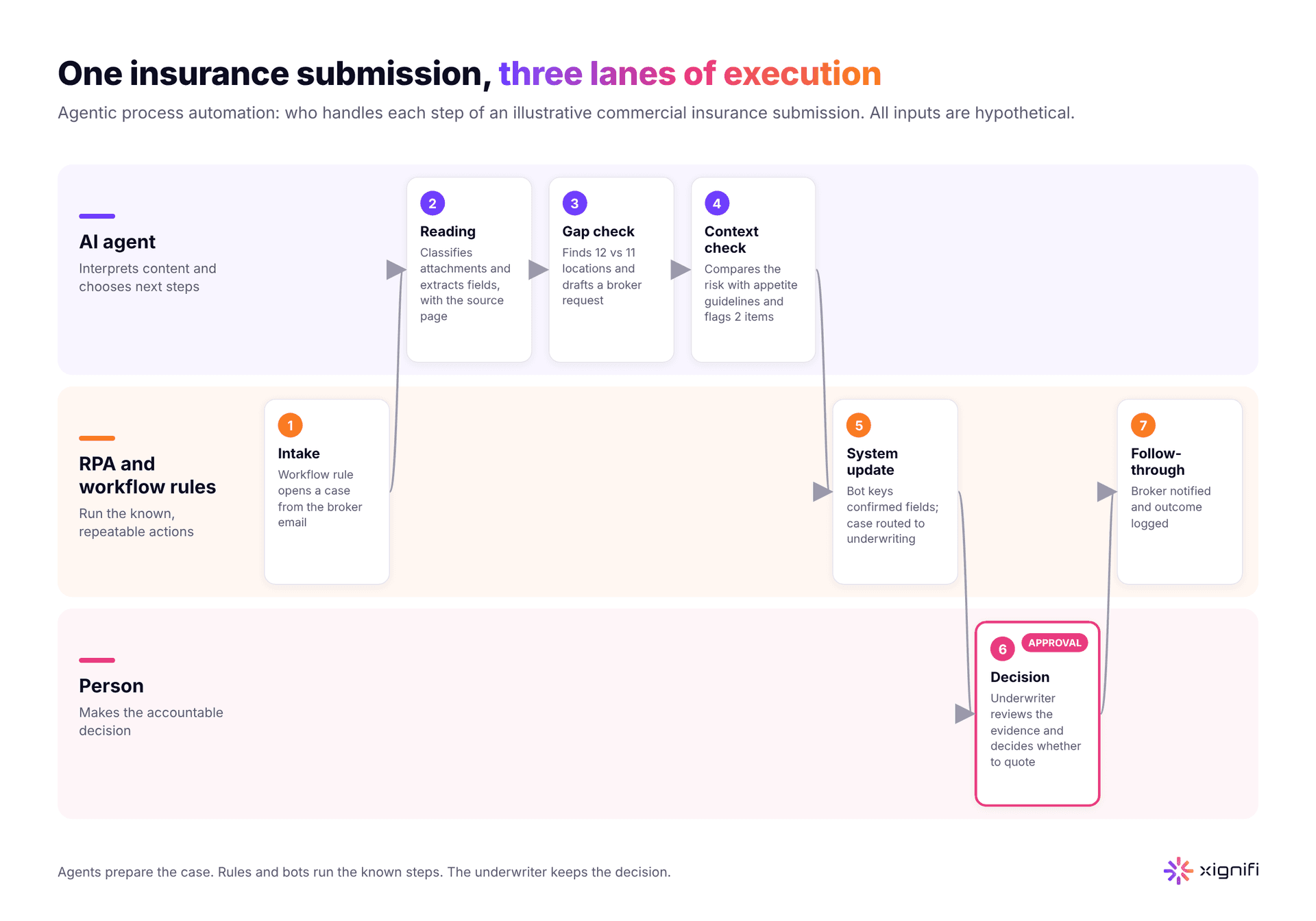
In an agentic process, one case uses three kinds of execution: AI agents interpret documents and choose next steps, deterministic tools such as RPA and workflow rules run known actions, and a person makes the material decision.
Illustrative arithmetic: if a team receives 400 submissions a week and 30 percent carry a conflict like the one in step 3, that is 120 cases a week where someone today finds the gap by hand. In this design, the agent finds it and drafts the request, and the underwriter sees only the resolved file. All figures are hypothetical.
What Roles Do RPA and Workflow Tools Play in an Agentic Process?
RPA still handles repeatable, UI-based actions with stable instructions, and workflow tools still own fixed routing, triggers, approvals, and predictable branches. Agents add reasoning where the next step cannot be fully specified in advance.
Microsoft Learn draws the same line. In a deterministic workflow, code controls the flow; in an agent-directed workflow, the agent chooses tools and sequence at runtime. A hybrid design is the sensible default, because a bot that reliably keys known fields has a predictable failure mode, and replacing it with an agent trades that predictability for flexibility the step does not need.
Xignifi calls this split the three-lane model: agents for interpretation, deterministic tools for known actions, and people for accountable decisions.
Which Component Should Handle Each Step in an Agentic Process?
Six common process steps, the component best suited to each (RPA, a workflow tool, an AI agent or a person), why that component fits, and the control to define before the step goes live.
| Process step (example) | Component best suited to the step | Why this component fits | Control to define before go-live |
|---|---|---|---|
| Copy a known field into a legacy screen | RPA | Repeatable UI action with stable instructions | Exception handling and bot failure alert |
| Route a complete case by a fixed rule | Workflow tool | Known conditions and a predictable branch | Rule owner and change control |
| Interpret an unfamiliar document or email | AI agent | Meaning depends on content and context | Confidence threshold and source evidence |
| Choose the next permitted step after an exception | AI agent within orchestration | Next action depends on intermediate results | Allowed tools, scope and escalation boundary |
| Approve a material business decision | Human decision-maker | Accountability and judgment stay with the organization | Named approver and recorded rationale |
| Record the outcome and notify the downstream team | Workflow or API action | Deterministic follow-through after a decision | Delivery status and audit record |
Use agents for interpretation and variable next steps, deterministic tools for known actions, and people for approvals where accountability or risk requires them. Treat the table as a starting point. Map one of your own processes against it before you choose any tools.
For a direct comparison of the two approaches, see Intelligent automation vs RPA: what IT leaders keep and add
What Should Enterprises Control Before Giving Agents More Autonomy?
Give agents only the access and tools a step needs, record everything they do, and send material decisions to a named person. Test on real exceptions first, and keep responsibility for the process with the business.
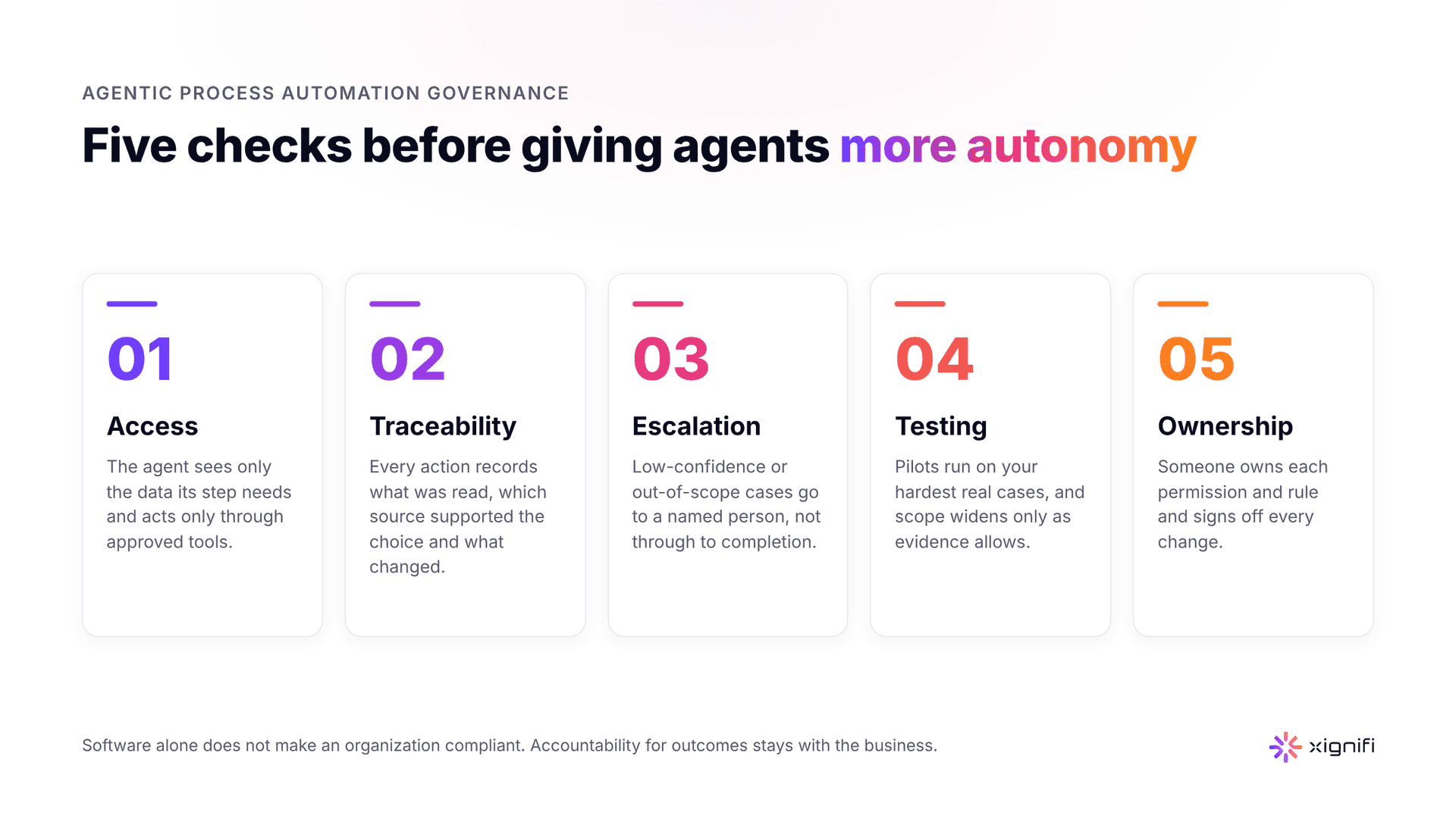
ServiceNow lists permissions, audit logging, monitoring, and human oversight among the controls agent deployments need. In practice, that comes down to five checks:
- Access: the agent sees only the data its step needs and acts only through approved tools. For example, an agent that drafts broker clarification emails can create drafts but not send them, and read the submission folder but not the policy system.
- Traceability: every action records what was read, which source supported the choice and what changed.
- Escalation: low-confidence or out-of-scope cases go to a named person, not through to completion.
- Testing: pilots run on your hardest real cases, not clean demo files, and scope widens only as evidence allows.
- Ownership: someone owns each permission and rule and signs off every change.
Are Your Controls Ready for AI Agents?
Rate your AI controls across nine layers and get a private Trust Score out of 45 in two minutes.
Get your Trust ScoreWhat Should Leaders Know About Agentic Process Automation?
What Is the Difference Between an AI Agent and an Agentic Workflow?
An AI agent is a single actor that reasons and acts within its permissions, while an agentic workflow is the sequence of steps in which agents choose what happens next. Agentic process automation adds the deterministic steps, systems, and human approvals around that workflow.
What Are Common Agentic Automation Use Cases?
Common agentic automation use cases are document-heavy processes with variable inputs and frequent exceptions. In insurance, that includes submission intake and triage, the focus of Xignifi's submission triage agent. Loan file review, customer onboarding and logistics exception handling follow the same pattern.
Can Agentic Automation Work With Existing RPA and Workflow Tools?
Agentic automation works alongside existing RPA and workflow tools rather than replacing them, and a hybrid design is often the sensible starting point. Bots keep handling stable screen actions, and workflow rules keep fixed routing, while agents take the steps that need interpretation. As Microsoft Learn notes, in a deterministic workflow, code controls the flow, which keeps those paths predictable and easier to audit.
Do You Need to Replace Legacy Systems to Use Agentic Automation?
Agentic automation does not usually require replacing legacy systems, because it works through the systems an enterprise already runs. Agents can read and write through APIs where they exist, and RPA can act on legacy screens that have none, so the process changes before the systems do.
Which Processes Suit Agentic Automation?
Processes suited to agentic automation are multi-step, high-volume, and exception-heavy, with inputs that vary in format and content. Submissions, loan files, onboarding, and shipping exceptions fit this pattern, especially when a reviewer can detect and correct errors.
How Do Enterprises Get Started With Agentic Process Automation?
Enterprises usually start agentic process automation with one exception-heavy process, map each step by the type of work, and pilot on real cases with approval points in place. Scope stays narrow until the pilot evidence supports more. Published Xignifi case studies show how other teams have scoped document-heavy work.
How Do You Measure Whether Agentic Process Automation Is Working?
Agentic process automation is best measured against your own baseline for the same process: turnaround time, exception rate, rework, and the share of cases escalated to people. Compare like for like, including the hard cases. For underwriting teams, Xignifi's guide to quote turnaround time covers one of these measures in detail.
What Are the Main Risks of Agentic Automation?
The main risks of agentic automation are wrong interpretations, actions outside the intended scope, unnecessary data exposure, and approvals given without real review. Each maps to a control: source evidence, narrow permissions, scoped data access and approval screens that show what the agent did.
How Do People Keep Control in Agentic Process Automation?
People keep control in agentic process automation through approval points on material decisions, permissions that limit what each agent can do and a record of every action they can review. Control also means someone owns each rule and permission and reviews changes to them.
How Is Agentic Process Automation Different From Hyperautomation?
Hyperautomation is a broad strategy for automating as many business and IT processes as possible with a mix of tools. Agentic process automation is narrower: it adds AI agents that interpret context and choose next steps inside a process, alongside the tools hyperautomation already uses.
Editor's Note: Start With the File Nobody Wants
Here is the test I would run before reading any vendor deck on agentic process automation. Ask your operations team for the file they dread. Skip the clean sample from the demo and take the one with the missing page, the scanned fax, and the note in the margin that changes everything.
That file tells you more than any feature list. Watch what the agent does with it. Does it notice the problem, and can it show you where it found it?
Then watch what it does next. Does it stop and ask, or does it guess and keep going? A system that guesses quietly is more dangerous than one that fails loudly.
I would also push back on the idea that agents should replace the automation you already run. Most of your bots are fine. They are dull, predictable and easy to audit, which is exactly what a step that never changes needs; the real gains sit in the handoffs between them, where a person still reads, checks, and chases.
Keep the ledger honest, too. Write down today's turnaround time and exception rate before the pilot starts, and put a cost on the backlog with the ROI calculator. If you cannot say what the work costs now, you will not be able to say whether the agent helped.
Agents can take the reading and the chasing off people's desks. The decision, and the signature under it, should stay with someone who can explain it.
Which AI Would You Actually Launch?
Make ten quick choices between AI setups that trade oversight against speed and cost. It takes two minutes.
Start the Trade-off Test