Intelligent document processing (IDP) for insurance is the use of optical character recognition (OCR), AI-based classification and data extraction to turn claim forms, applications and other documents into structured data. Validation then checks that data for completeness and consistency, and downstream decisioning uses it to move underwriting, claims and policy administration work forward.
Most insurers already hold the information their teams need. It sits inside scans, PDFs and email attachments, and someone has to open each file, read it and re-key the details before a claim, a policy or an underwriting decision can move. Intelligent document processing (IDP) is meant to remove that bottleneck, but the term covers more than reading text. The real questions are whether the extracted data is right, what happens when it is not, and who stays accountable for the decision. This guide covers the five stages, how to evaluate a tool on your own documents, and where human review still applies. Intelligent document processing (IDP) for insurance is the use of optical character recognition (OCR), AI-based classification and data extraction to turn claim forms, applications and other documents into structured data. Validation then checks that data for completeness and consistency, and downstream decisioning uses it to move underwriting, claims and policy administration work forward.
TL;DR
- What it is: IDP turns claim forms, applications and other documents into structured, checked data that policy, claims and underwriting systems can use.
- How it works: five stages, in order: OCR, classification, extraction, validation and downstream decisioning.
- The catch: OCR reads characters and extraction labels fields. Neither confirms that the data is correct, which is why validation and exception handling matter most.
- Where people stay: IDP prepares information for underwriting and claims decisions. Accepting a risk, paying a claim and setting a price stay with people and the insurer's own rules.
- How to choose: test on your own documents through a pilot, and compare tools on seven measures: document variation, extraction accuracy, exception rates, integration, security, traceability and operational impact.
- What to plan for: poor scans, missing fields, inconsistent formats and ambiguous values. Each needs a defined path to a person.
- The question to ask any vendor: "What is your accuracy per field, on which documents, and where do uncertain cases go?"
What is intelligent document processing in insurance?
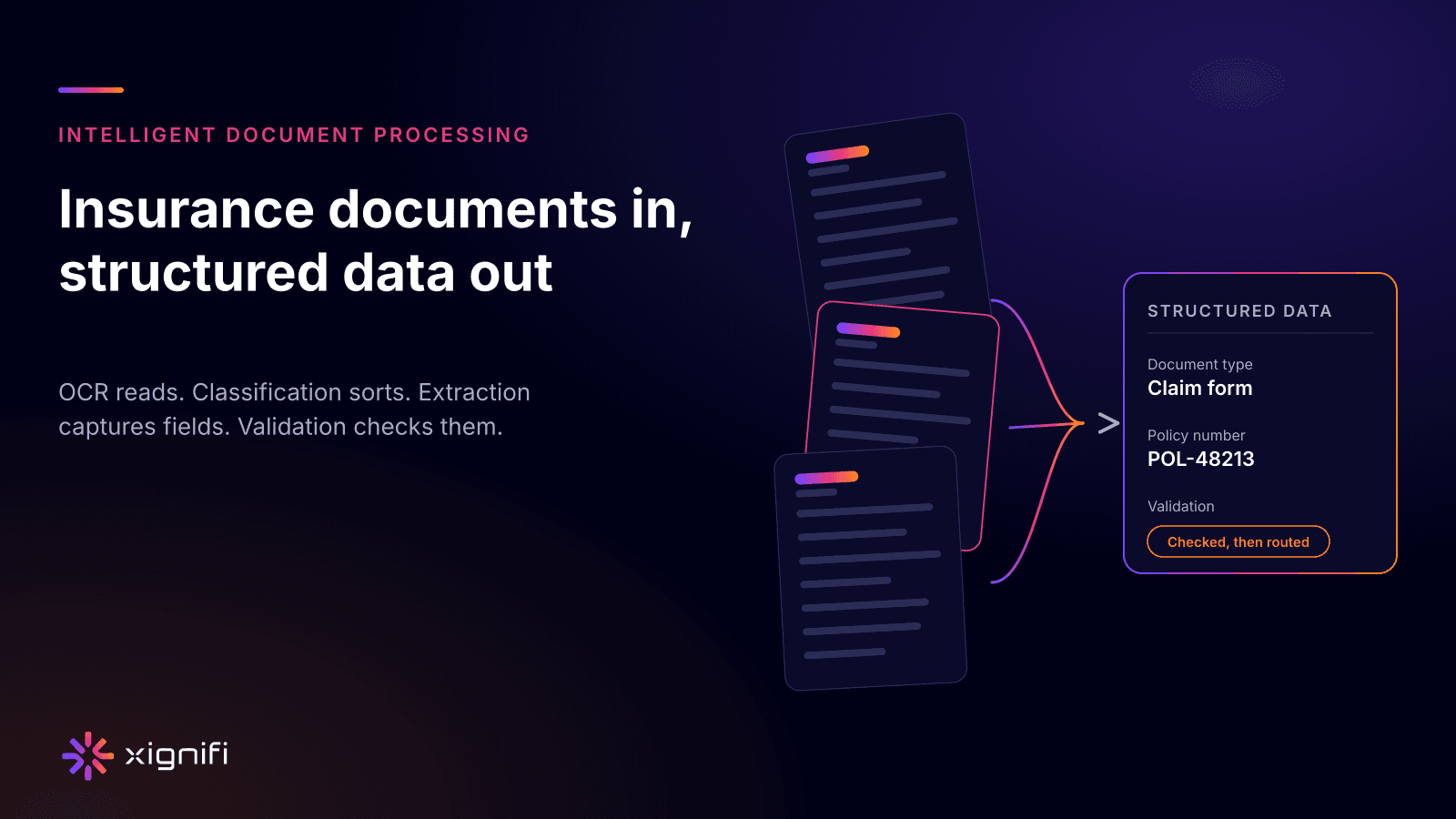
IDP is a set of technologies that read documents and turn their content into structured data. In insurance, that data feeds the systems and teams that handle policies and claims. Insurers receive a wide mix of documents. Claim forms, policy applications, invoices and supporting evidence such as reports, photos and emails all arrive in different formats. Some are forms with fixed fields. Others are scans, attachments or free text with no fixed layout. Staff may read these documents and key the details into core systems by hand. That work is repetitive and grows with volume. IDP aims to capture the details automatically, so people spend their time on the cases that need judgement. The word intelligent refers to the steps beyond text recognition. IDP also sorts documents by type, finds the fields that matter and checks the values. The next section lists the five stages.
What are the stages of intelligent document processing?
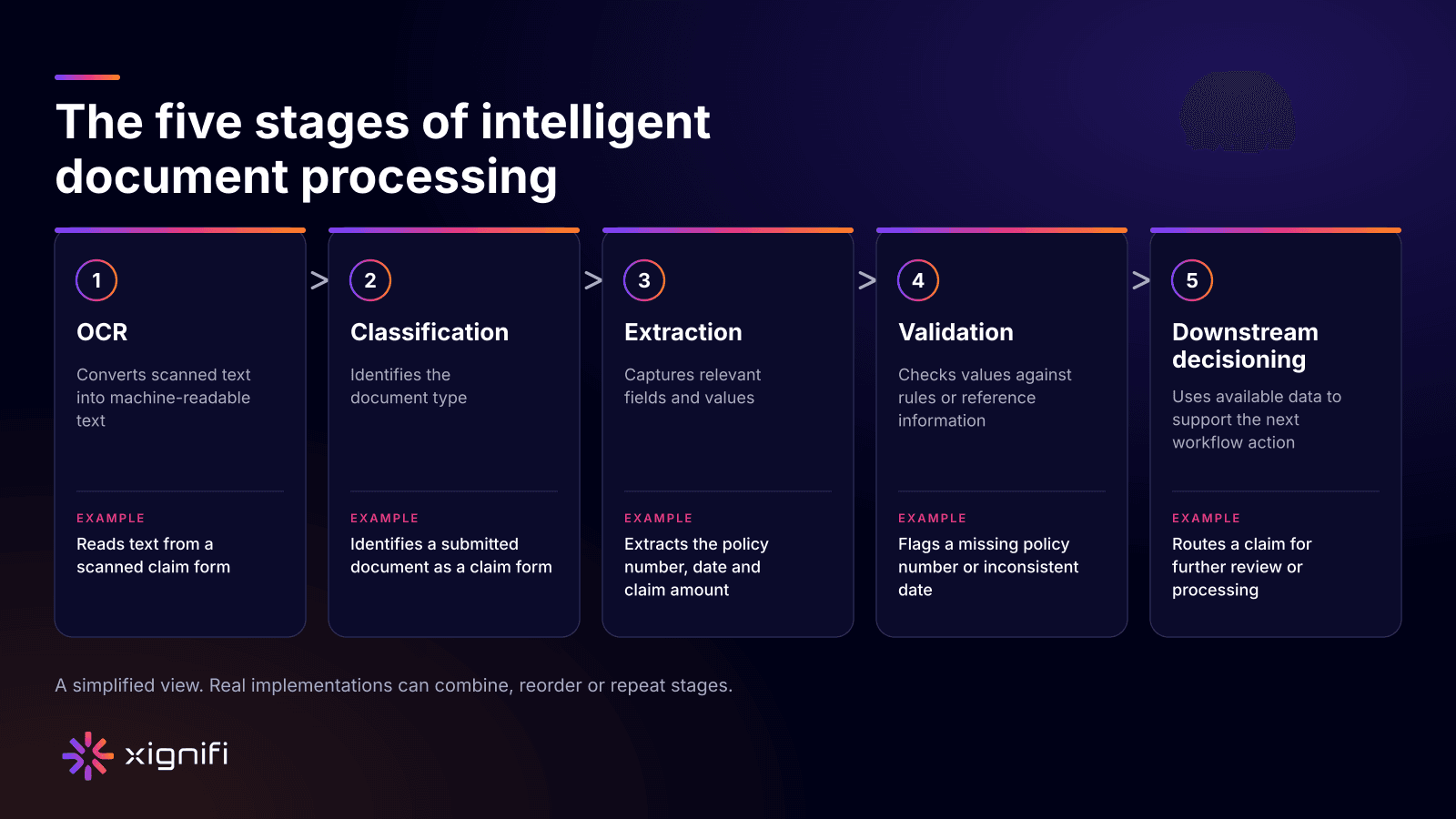
IDP runs in five stages: OCR, classification, extraction, validation and downstream decisioning.
Table 1: The five stages of intelligent document processing in insurance, with an example of each
| Stage | What it does | Insurance example |
|---|---|---|
| OCR | Converts text in scanned documents or images into machine-readable text | Reads text from a scanned claim form |
| Classification | Identifies the document type | Identifies a submitted document as a claim form |
| Extraction | Captures relevant fields and values | Extracts the policy number, date and claim amount |
| Validation | Checks values against rules or reference information | Flags a missing policy number or inconsistent date |
| Downstream decisioning | Uses available data to support the next workflow action | Routes a claim for further review or processing |
This is a simplified view. Real implementations can combine, reorder or repeat stages. Validation checks consistency, and it does not prove that the source information is true.
See how IDP fits your insurance workflow
Explore how document extraction can help structure insurance data and prepare it for downstream processing.
Explore Xignifi's document extraction workflowHow does OCR differ from AI document extraction?
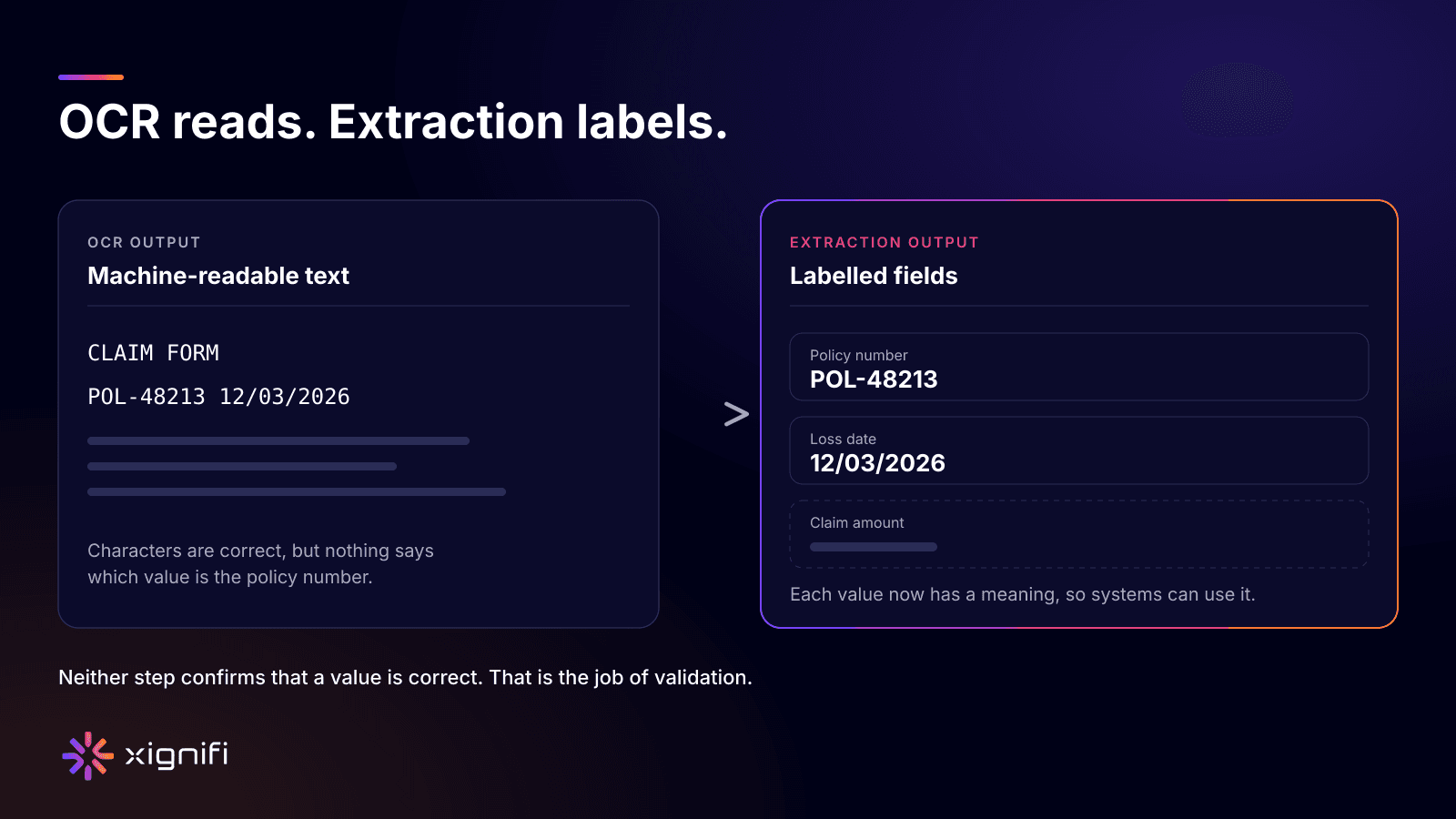
OCR reads the text on a page, and AI document extraction works out what that text means and returns it as labelled fields. OCR converts text in an image or scanned document into machine-readable text. If a claim form arrives as a scan, OCR turns the pixels into characters. OCR does not know what those characters mean. Take an illustrative policy number such as POL-48213 and a date such as 12 March 2026. OCR can read both correctly and still not know which is the policy number and which is the loss date. It also cannot tell whether either value is right. AI document extraction does the second job. It identifies specific fields, such as policy number, claimant name or claim amount, and returns each one as a labelled value. Some extraction approaches handle documents whose layouts differ from one another. How well they do so varies by document type and image quality, so test on your own documents. Neither OCR nor extraction confirms that the information is correct.
How do document classification and validation work?
Classification identifies what kind of document has arrived, and validation checks the values extracted from it. A claim form, a repair invoice and a policy application each need different fields and different handling, so the system sorts them first. Validation then checks the extracted values. It can test whether required fields are present, whether a date is plausible, or whether a value matches a record held in another system. Here is a simple example. A document arrives as a scan, and the system classifies it as a claim form. It extracts the policy number, then checks that the number has the expected format and matches a record in the policy system. If it does not match, the document goes to a person.
How does IDP support insurance underwriting and claims?
IDP supports the administrative steps around underwriting and claims. These are intake, data capture, checks, routing and preparing information for a later decision. In claims, a notice of loss may arrive by email with several attachments. IDP can classify each attachment, extract the claim details, check them against the policy record and route the file to the right queue. In underwriting, an application and its supporting documents can be read and the data placed in the underwriting system. The underwriter then reviews a structured file instead of assembling one by hand. Administrative automation is different from a decision. Whether to accept a risk, pay a claim or set a price depends on business rules, human judgement or authorised approval. IDP prepares the information for those steps. It does not replace them.
What happens after document data is extracted?
Downstream decisioning uses structured, validated data to drive the next step in a workflow. Extraction ends once the values are captured. What happens next is a separate stage. Validated data can pass to a business rules engine, to existing applications such as a claims or policy administration system, or to AI agents that support the next step. This is where the agentic AI platform from Xignifi fits. The platform connects systems, processes information, automates workflows and deploys AI agents that support operational decisions. Four requirements decide whether this works in practice:
- Integration: the data must reach the systems the team already uses, including older ones.
- Exception handling: documents that fail validation need a defined path to a person.
- Auditability: the team can see what was extracted, what was checked and what happened next.
- Human review: the insurer's own rules set the points where a person must confirm or approve.
A decision supported by AI is only as good as the data and rules behind it. Clean extraction and clear exception paths come first.
Move from extracted data to faster insurance workflows
See how Xignifi can help reduce manual document handling and move information into the next operational step.
What should insurers evaluate in an IDP solution?
Insurers should evaluate an IDP solution on their own documents, using seven measures: document variation, extraction accuracy, exception rates, integration, security and data handling, traceability and operational impact. A demo on clean samples says little about how a tool handles your mix of scans, forms and emails.
- Document variation: how many document types and layouts the tool handles, including poor scans.
- Extraction accuracy: measured per field on your documents, not quoted as one overall figure.
- Exception rates: how many documents need manual review, and why.
- Integration: how data reaches your policy, claims and underwriting systems.
- Security and data handling: where documents are stored, who can see them and how long they are kept.
- Traceability: whether each value can be traced back to its source document.
- Operational impact: the effect on turnaround time, backlog and staff effort, compared with your current baseline.
A defined pilot is the most reliable way to assess these. Pick a representative set of documents, including difficult ones. Agree the measures before the pilot starts, and compare the results with your current process. Treat unsupported vendor claims with caution. An accuracy percentage with no test conditions, document types or sample size cannot be compared with anything.
What are the limitations of intelligent document processing?
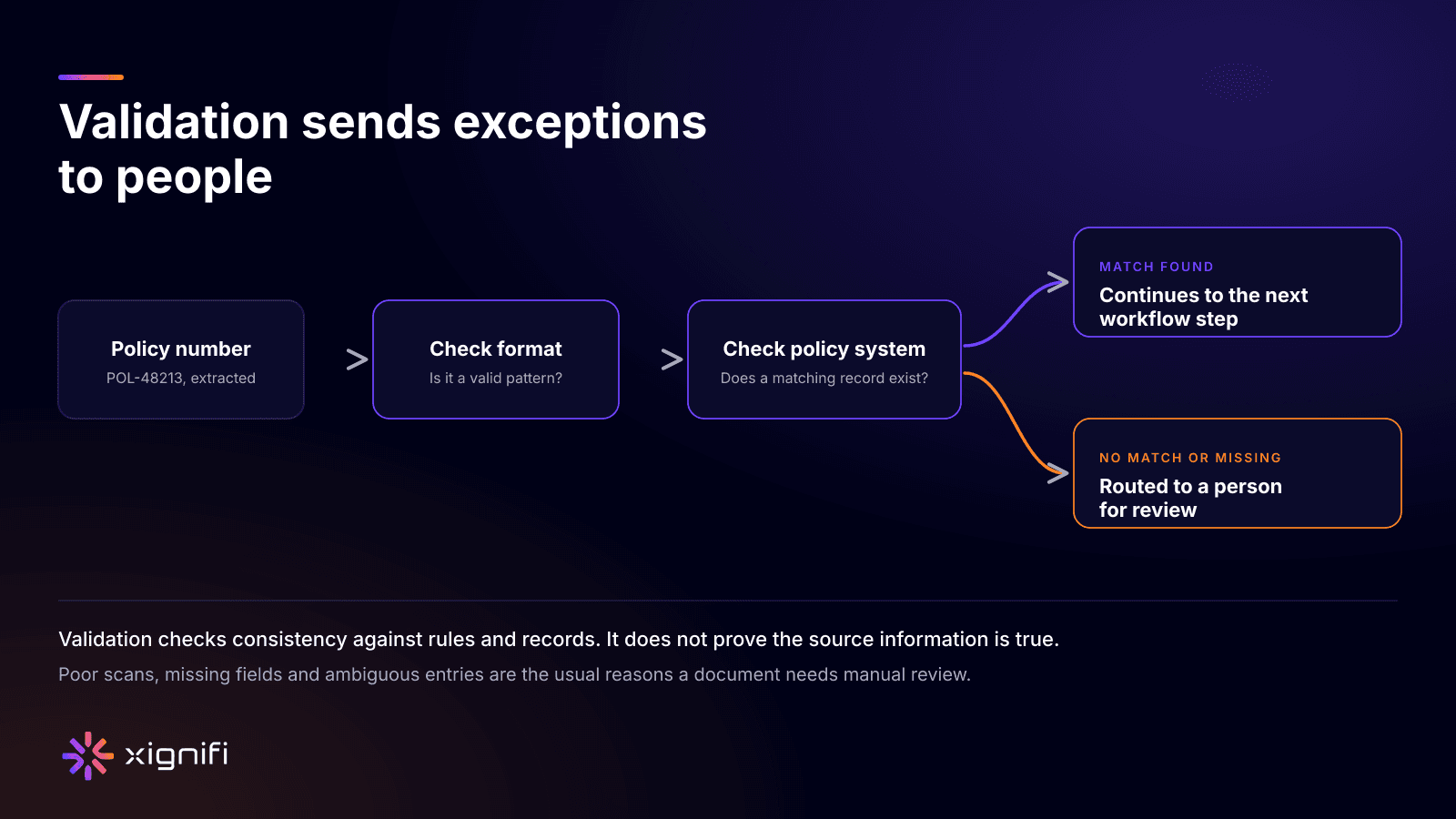
IDP does not guarantee error-free processing. Several conditions call for extra checks or manual review. Poor scan quality is one. Faded print, skewed pages and handwriting can cause misread characters. Missing fields are another. If a form leaves the policy number blank, there is nothing to extract. Inconsistent formats cause problems too. The same field can sit under different labels or in different places on documents from different sources. Ambiguous information, such as a date that can be read two ways, may need a person to resolve it. Validation has limits as well. It can show that a value conflicts with a record. It cannot confirm that the source document is true. For these reasons, a well-run implementation routes uncertain cases to people and keeps a record of what happened. Human oversight remains part of the process.
Frequently asked questions about intelligent document processing for insurance
OCR converts images of text into machine-readable characters, so a scanned claim form becomes text a system can read. IDP adds classification, field extraction and validation on top. The output is labelled, checked data, such as a policy number and a loss date, that insurance systems can use. See how the Xignifi Document Extraction workflow applies these steps to your documents.
Editor's note: where I would start with document automation
The first question usually asked about intelligent document processing is how accurately it reads a form. It is a fair question, and also the easiest one to answer in a demo. I would begin elsewhere. Reading text is the first of five stages, and what earns the trust of a claims or underwriting team is what happens around it: what is checked, what is flagged and where an uncertain case goes. So I judge any IDP tool by its exception path before its accuracy, and I treat auditability as a design requirement from day one. A system that handles the easy documents quietly and hides the difficult ones does more harm than one that stops and asks. Start with one document type and one workflow, agree the measures before the pilot, and compare the results with your current process, not an ideal one. Accepting a risk, paying a claim and setting a price belong to people and to the insurer's own rules. The job of IDP is to give those people a clean, checked file sooner, and that is also the foundation for agentic AI, because agents are only as good as the data and rules behind them. Test on your own documents, plan for the exceptions and keep people in the decisions that need them. It is the standard we aim to meet at Xignifi, and the one I would ask any vendor to meet
Put your insurance documents to the test
See how intelligent document processing could work with your documents, from data extraction to validation and exception handling.